Virginia’s proffer laws create a difficult Catch-22 for growing counties like Stafford: the County needs to build school capacity before classrooms become overcrowded, but once taxpayers finance those new seats, the available capacity can limit what Stafford can justify asking later residential rezonings to contribute toward additional school capacity.
Stafford County Public Schools says its FY2027 Capital Improvement Plan identifies more than $1.9 billion in school capital project costs, including roughly $1.7 billion in major projects and another $224.8 million for repairs, replacements and renovations.
At the same time, Stafford’s proposed FY2027 budget says education-related debt represents more than 78% of the County’s total debt, largely driven by construction of three new schools over a two-year period.
If residential growth creates the need for more schools, why can’t Stafford simply make developers pay for them?
The answer is more complicated than it sounds. Virginia law places significant restrictions on residential proffers. The school capacity taxpayers build today can become the available capacity used to evaluate the impact of tomorrow’s residential rezoning.
That does not mean developers never contribute to schools, and it does not mean Stafford should wait for overcrowding before building. It means there can be a disconnect between who finances school capacity, when it is constructed and what the County may later justify asking a residential development to contribute.
First, what exactly is a proffer?
When a property owner asks Stafford to rezone land for additional residential development, the project may create new demands for public infrastructure. More houses can mean more students, traffic and demand on parks, fire and rescue facilities and other public services.
Developers can offer commitments known as proffers to address impacts associated with a rezoning. Some involve cash contributions. But Virginia does not give Stafford unlimited authority to demand money simply because a project will add residents.
For residential development, Virginia Code § 15.2-2303.4 says a proffer must address an impact specifically attributable to the proposed development. For an off-site proffer, including a cash proffer, the development must create a need—or an identifiable portion of a need—for a public-facility improvement beyond the existing capacity available when the rezoning is considered. The development must also receive a direct and material benefit from the improvement.
That phrase—existing public-facility capacity—is central to the issue.
Here is what that means in plain English
Consider a simplified example. An elementary school has 1,000 seats and 980 students. A proposed rezoning would generate 100 more students. Without added capacity, enrollment would reach 1,080—80 students beyond the school’s capacity.
Now change the timeline. Before the rezoning arrives, Stafford plans ahead and finances enough school construction to increase area capacity to 1,500 seats. The same 100 students would bring enrollment to 1,080, leaving seats available.
The development still produces students who need classrooms, teachers, buses and services. But it no longer creates the same additional capacity shortage because taxpayers already financed the seats. That distinction matters under Virginia’s proffer law.
Illustrative example: The 980-student, 100-student and 1,500-seat figures above explain the legal concept. They are not actual figures for a specific Stafford school or rezoning.
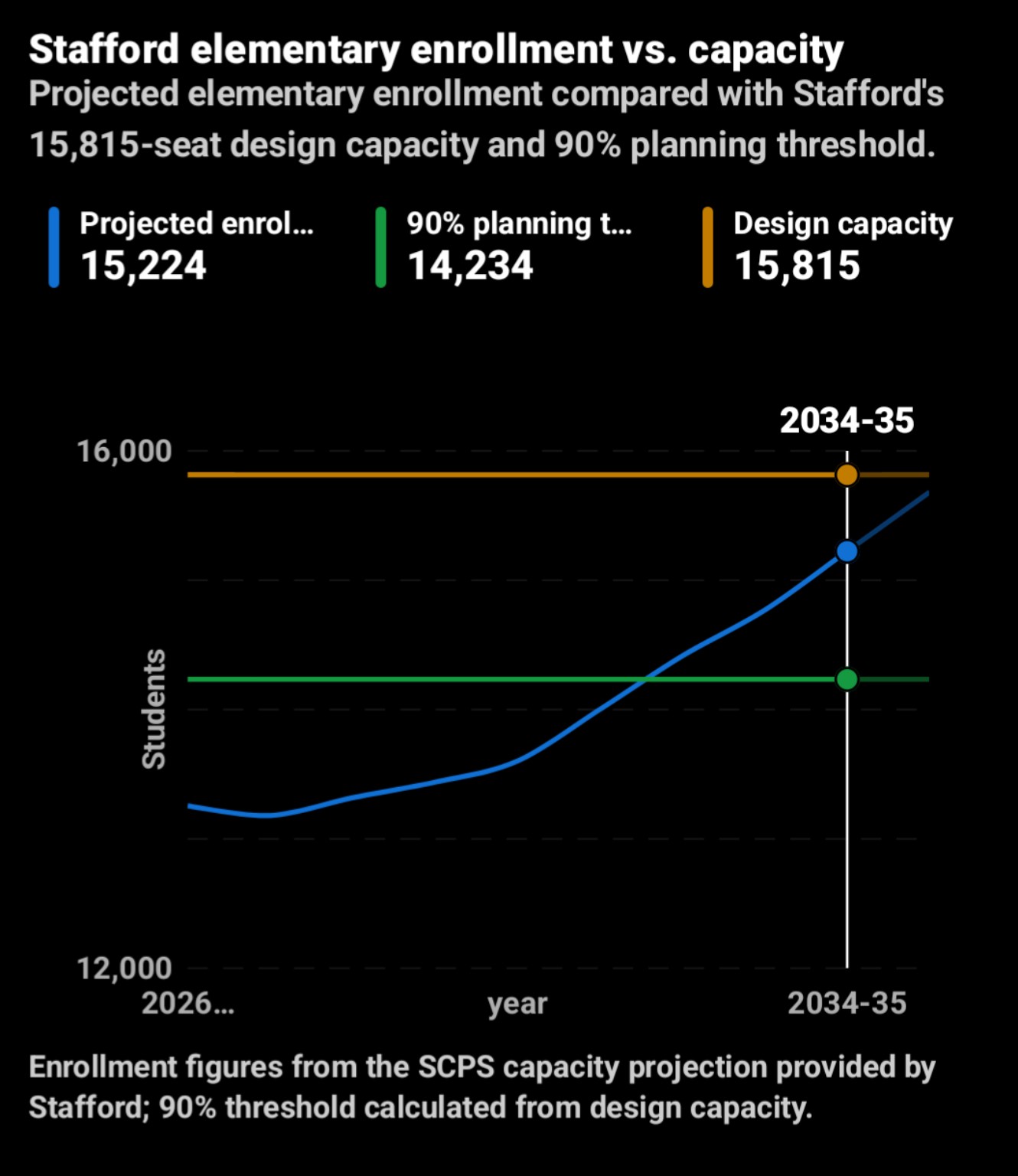
Taxpayers may still be paying for those seats
The school did not appear for free. Stafford may have borrowed tens or hundreds of millions of dollars to build it, and the County can continue making debt payments long after construction is complete.
Once the building exists, however, those classrooms become part of Stafford’s existing school capacity. Stafford can therefore have both available seats and outstanding taxpayer-supported debt that helped create them. Those are not the same thing.
Virginia’s residential proffer law focuses on an attributable impact and whether additional public-facility capacity is needed. It does not simply ask who originally paid for the seats that already exist.
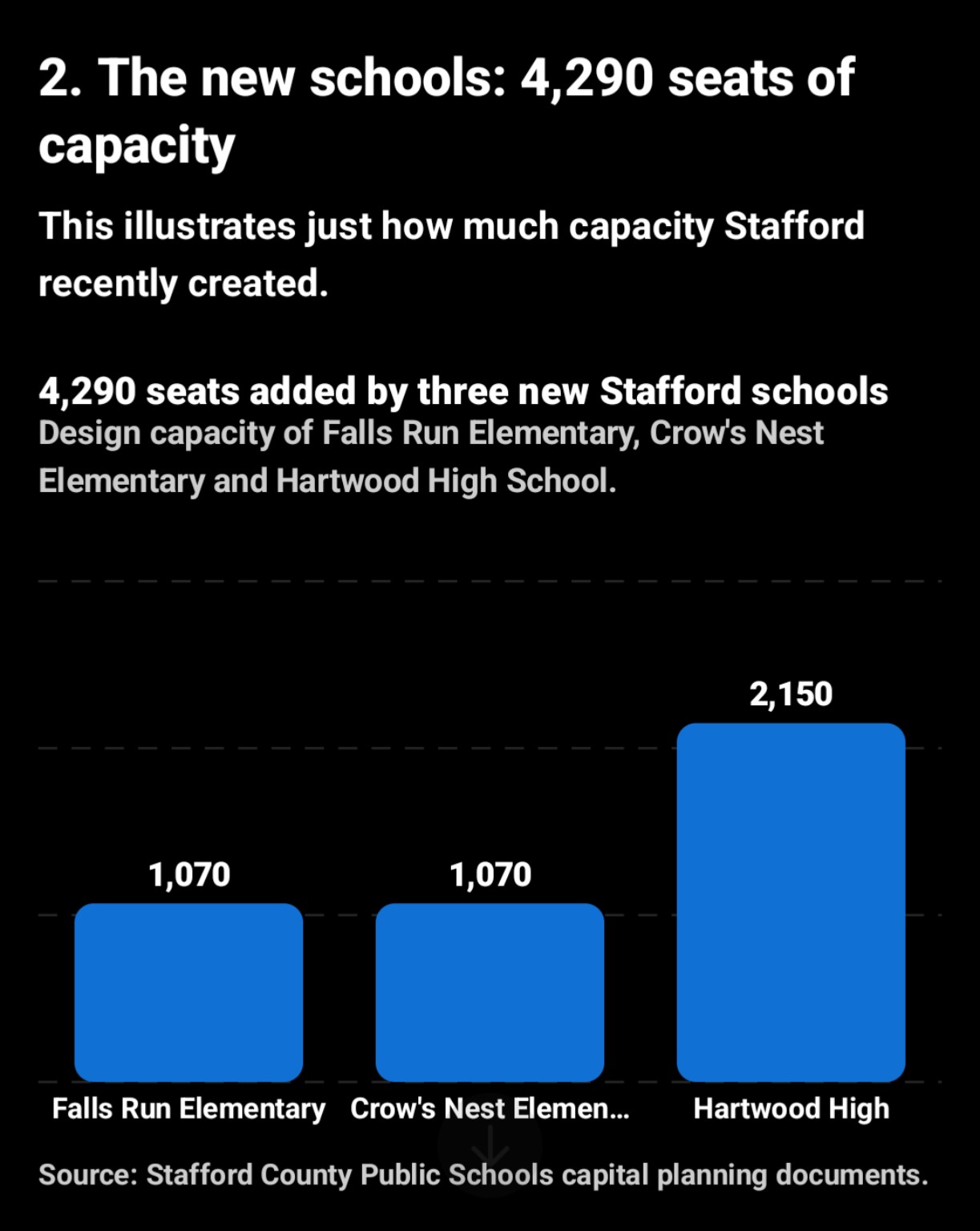
Stafford’s own records show that capacity matters
A residential project proposed in the Stafford Hospital area offers a useful local example. The applicant’s impact statement says the development would affect Stafford Elementary School, Stafford Middle School and Brooke Point High School.
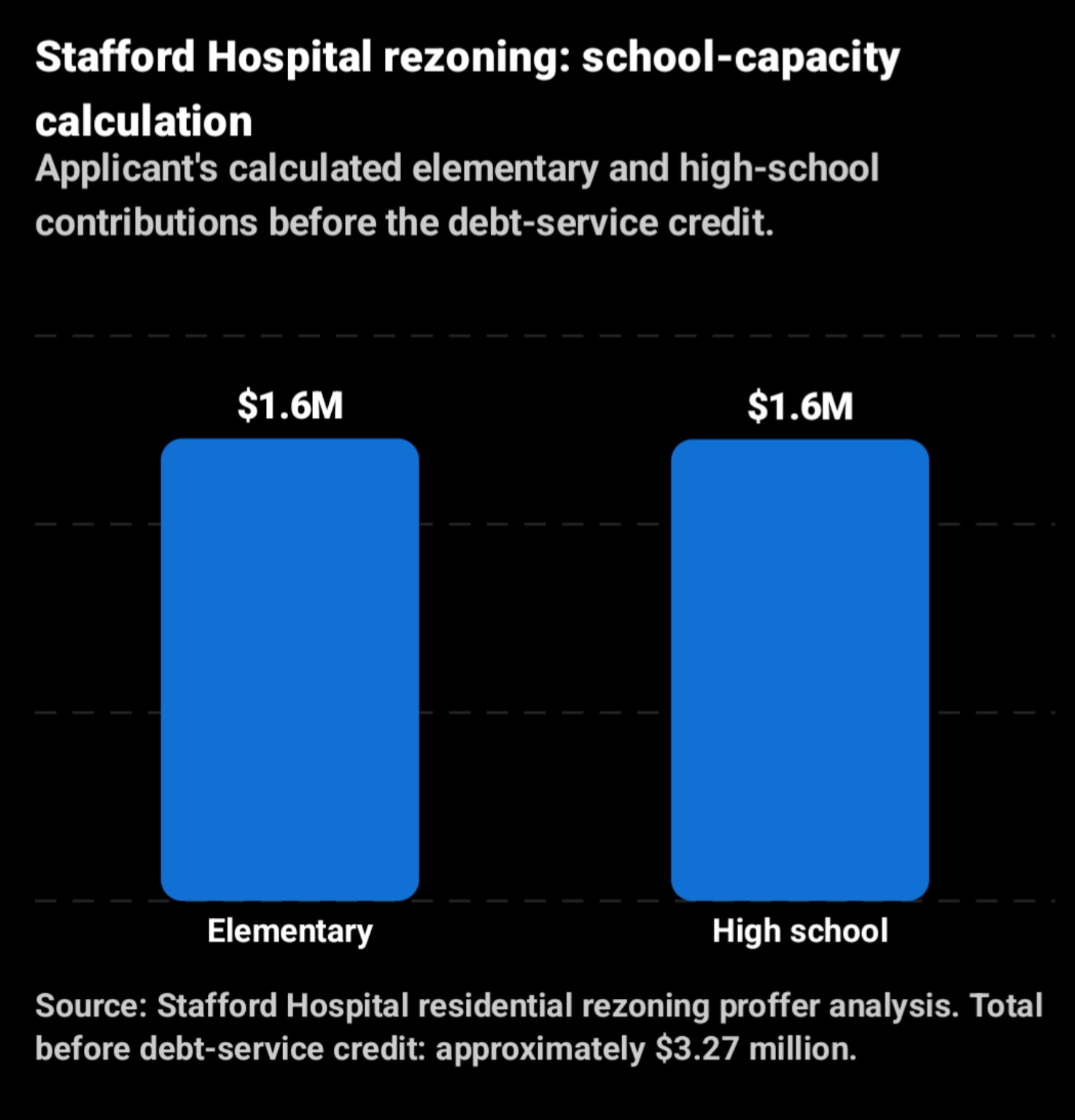
According to the applicant, the proposed development would cause the elementary and high schools to exceed maximum capacity. The analysis calculated approximately $3.27 million in elementary- and high-school contributions before a debt-service credit. The applicant’s stated aggregate cash school proffer after that credit was $2,717,533.
That is an important real-world example: when a development contributes to a documented capacity problem, proposed school mitigation can reach into the millions. When Stafford has already created enough capacity to absorb projected students, the equation can change.
By-right development changes the calculation, too
Not every home in a proposal necessarily counts as a new impact caused by a rezoning. Virginia’s statute generally focuses on additional dwelling units beyond what the existing zoning already permits when a rezoning or proffer amendment is required.
The Stafford Hospital impact statement illustrates the concept. It estimated that development under the existing zoning could generate approximately 3.79 school-age students without school-improvement proffers. So a project’s total number of students is not automatically the number Stafford can use for a school proffer. The underlying zoning matters.
Proffer money cannot pay for everything schools need
Virginia law also prohibits cash proffers from being used for ordinary operating expenses or for improvements to existing facilities—such as renovations or technology upgrades—that do not expand capacity.
That matters because Stafford’s more than $1.9 billion FY2027 school capital plan is not exclusively a growth plan. It includes aging-school replacements, critical building systems, new schools and additions, classroom modernization, and transportation and support facilities.
Not all of those needs can simply be assigned to residential developers. The argument that Stafford should “make developers pay the $1.9 billion” does not accurately describe what Virginia law allows.
The Catch-22: wait or build ahead
Wait: Stafford could delay capacity until schools become severely crowded. That may make the connection between a new development and additional capacity easier to demonstrate, but students could spend years in overcrowded buildings while another facility is planned, financed and constructed.
Build ahead: Stafford can forecast growth, borrow money and provide classrooms before conditions become severe. That is responsible capital planning. But once those seats exist, later residential development can consume them without creating the same additional capacity shortage that would have existed before construction. Taxpayers may still be servicing the debt.
Growth pushes schools toward capacity → Stafford finances construction → taxpayers begin paying debt → the project creates available seats → later development consumes some of those seats → remaining capacity declines → Stafford eventually plans again.
This does not mean developers pay nothing
An applicant can voluntarily submit onsite or offsite proffers it considers reasonable and appropriate. Developers may provide infrastructure or other commitments based on a project’s circumstances. And once new homes are occupied, their owners become Stafford taxpayers who support schools, County services and debt.
The issue is therefore not simply “taxpayers pay and developers do not.” The more precise question is: Who finances the upfront infrastructure required for growth, and how much of that cost can Stafford legally attribute to developments that eventually consume the capacity?
Now voters are being asked about another way to pay
Stafford voters will decide in November whether the Board of Supervisors should receive authority to impose an additional local sales and use tax of up to 1% for eligible school capital projects. Stafford Schools says it could generate at least $13 million per year, depending on taxable sales activity.
The referendum would authorize the Board to impose the tax; voter approval would not automatically set the rate at the full additional 1%. If later imposed at the full amount, Stafford Schools says the combined rate would increase from 5.3% to 6.3%.
Save Stafford is not telling readers how to vote. The referendum adds urgency to a larger question: how should a growing county fairly finance schools while it is already carrying substantial education-related debt?
The question is not whether Stafford should stop building schools
It should not. Schools take years to plan and build, and an empty classroom in one part of Stafford does not necessarily solve crowding elsewhere. The system also needs flexibility for attendance boundaries, special programs and enrollment changes.
The problem is that Virginia’s growth-financing system can create tension between responsible planning and Stafford’s ability to obtain mitigation for later residential growth. Build too late and students endure crowding. Build early and taxpayers finance capacity before some of the development that will use it arrives.
Questions to ask with every major residential rezoning
- How much taxpayer-funded school capacity will this development consume?
- Who paid to create that capacity, and is Stafford still paying debt on it?
- Which school impacts are specifically attributable to the rezoning?
- What is the development contributing toward those impacts?
- When today’s available capacity is gone, who will pay for the next school?
Those questions do not predetermine whether a project should be approved or denied. They give taxpayers a clearer view of its long-term financial consequences.
Stafford’s school-funding debate is bigger than a 1% sales tax
Virginia law requires a connection between residential proffers and impacts specifically attributable to a development. For off-site proffers, existing public-facility capacity is explicitly part of the equation. Stafford, meanwhile, must build infrastructure before every future student arrives.
Those realities can collide. Taxpayers build capacity. Growth consumes capacity. Debt can remain long after the seats are built. Eventually, Stafford may need to build again.
As voters debate another source of school-construction revenue, understanding that cycle may be just as important as deciding how the next school gets paid for.
Sources, documents & image credits
Read the original record
Code of Virginia § 15.2-2303.4 — Proffers for residential developmentCurrent Virginia law reviewed September 19, 2026 · Open original source ↗Stafford County Public Schools — budget and capital planningFY2027 capital plan and capacity materials · Open original source ↗Stafford County — Budget and Capital Improvement ProgramFY2027 budget and debt information · Open original source ↗Stafford County Planning and Zoning — public application recordsStafford Hospital residential rezoning and proffer analysis · Open original source ↗Stafford County — official meeting agendas and recordsPublic land-use and budget records · Open original source ↗Compare Stafford’s budget, school debt and other major financial commitments.
View financial record →Support Save Stafford
Independent local information. No paywalls. No advertising.Research like this takes time and sometimes requires obtaining public records. Community support helps Save Stafford continue making this information freely available.
No subscription required. Contribute only if you choose. Financial contributions do not purchase editorial influence.