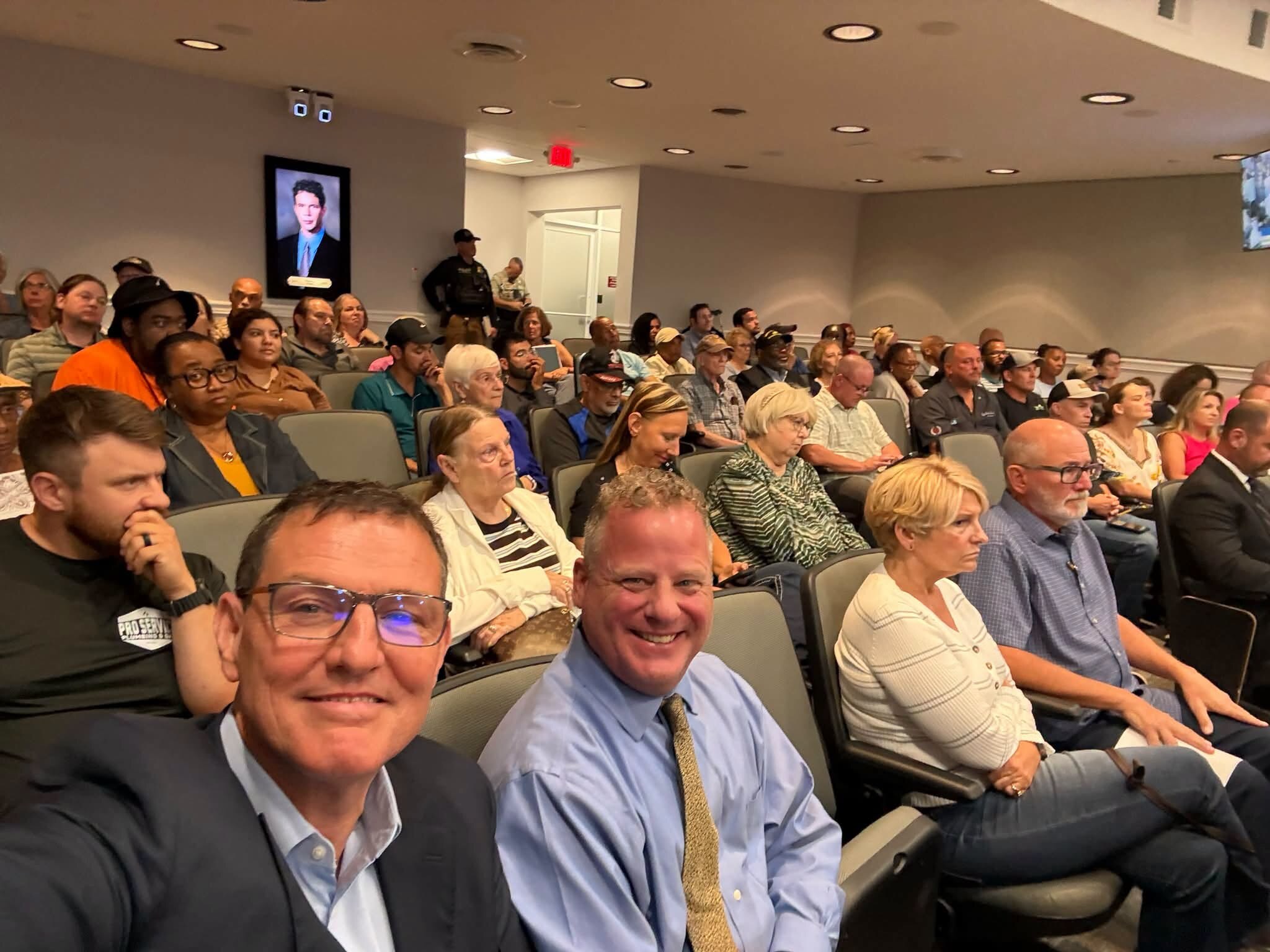
The Stafford County Board of Supervisors meeting that began September 15 did not end until 12:59 a.m. September 16. The biggest decision came near the end: the proposed Business, Professional and Occupational License tax—commonly called BPOL—failed.
Fredericksburg Free Press reported the final adoption vote as 2–5, with Supervisors Pamela Yeung and Kecia Evans supporting the ordinance and the other five supervisors voting against it. Stafford will remain without a BPOL tax for now.
But the nearly eight-hour meeting was about considerably more than one tax. Supervisors also confronted school construction, county borrowing, infrastructure, economic development, industrial rezonings and reclaimed-water infrastructure. Together, those issues help explain why the BPOL debate became so contentious.
What Stafford was considering
BPOL is different from an income tax. It is generally assessed against a business's gross receipts—revenue before expenses—rather than its profit.
Under Stafford's advertised proposal, businesses below $2 million in annual gross receipts generally would have paid a $50 license fee. Businesses crossing that threshold generally would have become subject to BPOL on qualifying receipts beginning with the first dollar, rather than receiving a $2 million deduction.
The principal rate discussed for several business classifications was $0.16 per $100 of gross receipts. Wholesalers were proposed at $0.05 per $100, while other classifications and fees were contained in the ordinance.
That distinction matters. A company with $3 million in revenue does not necessarily have anything close to $3 million in profit. Payroll, subcontractors, inventory, insurance, rent, equipment, utilities and other expenses can consume much of that revenue. That was at the center of the opposition from businesses.
Stafford did not know exactly how much BPOL would collect
Commissioner of the Revenue Scott Mayausky cannot currently require Stafford businesses to report their gross receipts because Stafford does not impose BPOL. The County therefore does not possess a complete database showing exactly how much taxable gross-receipts revenue exists.
The frequently discussed estimate of approximately $3.5 million to $4 million annually was an estimate—not a known collection amount. And even that figure did not represent entirely new net revenue.
Stafford currently receives roughly $1.1 million annually from the Merchants' Capital Tax, which was expected to be affected by the proposal. Implementation also would have required two additional positions and software for the Commissioner of the Revenue's office. Previous estimates placed annual administration around $300,000 to $350,000.
Using those estimates strictly as an illustration leaves roughly $2.05 million to $2.6 million in potential additional net revenue. That is not a County-certified forecast; it is a calculation using the publicly discussed estimates.
Residents and businesses turned out against the proposal
The public hearing lasted for hours. Most speakers described in local reporting opposed implementing BPOL. Opponents included Stafford residents, business owners and regional business organizations.
The Fredericksburg Regional Chamber of Commerce and the Fredericksburg Area Association of Realtors opposed the proposal. A separate No BPOL Stafford campaign said its petition had collected more than 2,000 signatures before the hearing. That figure comes from the campaign and is not a County-certified petition count.
Opponents argued that taxing gross receipts can affect businesses differently depending on profit margins, that Stafford's absence of BPOL has historically been used as an economic-development advantage, and that businesses were already facing rising costs. Supporters questioned whether homeowners should continue carrying such a large portion of the County's revenue burden while Stafford faces growing expenses.
Stafford itself once advertised “No BPOL”
The argument that Stafford's lack of BPOL has been an economic-development advantage did not originate with this year's opposition campaign. Stafford County itself previously marketed it that way.
“No gross receipts (Business Professional Occupation or BPOL) Tax.”
County recruitment material told prospective businesses that BPOL taxes imposed elsewhere did not exist in Stafford. Supervisors were therefore considering a tax whose absence the County had previously promoted as a reason to locate a business here.
The Board was deeply divided
Supervisor Pamela Yeung moved to adopt the advertised ordinance, arguing that Stafford needs additional ways to fund County services rather than continuing to rely so heavily on residential property owners. Supervisor Kecia Evans joined Yeung in supporting adoption, but the final ordinance failed 2–5.
That result differed from the earlier vote merely to hold the hearing. In August, Chairman Deuntay Diggs and Supervisors Maya Guy, Pamela Yeung and Kecia Evans supported moving the proposal forward for public consideration. Supervisors Crystal Vanuch and Tinesha Allen opposed advertising it, while Darrell English was absent. Holding a hearing was not the same as supporting the tax.
The voting process became confusing
Vice Chair Maya Guy participated remotely. Earlier in the meeting, Vanuch attempted to remove the BPOL hearing from the agenda. That motion was initially announced as passing 4–3. Guy then indicated that she had voted incorrectly, the Board recalled the vote, and the attempt to remove BPOL from the agenda failed.
Later, Yeung moved to adopt the ordinance and Vanuch made a motion to deny it. There was further confusion over which motion was before the Board. The motion to deny failed, returning supervisors to Yeung's original motion to adopt. That motion also failed.
Because the meeting ended after midnight and final approved minutes were not available when this article was prepared, the sequence and individual votes should be checked against Stafford's official record when it is posted.
Diggs pointed to the problem that remains
Although BPOL failed, Chairman Deuntay Diggs raised what may ultimately be the more consequential issue: rejecting BPOL does not eliminate Stafford's financial obligations.
During the discussion, Diggs referenced roughly $44 million that needs to be filled and approximately $1.9 billion in identified school capital needs. Those figures connect directly to another major subject on the same agenda—school construction and debt.
Stafford was considering more school borrowing the same night
Supervisors also had before them authorization for the issuance of general obligation school bonds through the Virginia Public School Authority to support approved school capital projects.
Stafford County Public Schools has identified more than $1.9 billion in long-term capital needs, including major construction, replacement, renovation and repair projects. That does not mean Stafford has already borrowed $1.9 billion; it represents identified long-range needs. But it illustrates the scale of the financial pressure facing future Boards.
BPOL may have failed. The school construction requirements did not disappear with it.
Hartwood Elementary was also on the agenda
The Board considered action involving proffered land for the Hartwood Elementary School replacement project. The item involved acknowledging a right-of-entry agreement between Stafford County Public Schools and Westlake Development and accepting the proffered property once conveyed.
Hartwood Elementary is one of the major replacement projects in Stafford's capital planning. The same meeting that produced hours of debate over several million dollars in potential BPOL revenue also contained another piece of Stafford's much larger school-capital program.
Reclaimed water and future infrastructure
Another agenda item involved Stafford's Northern Reclaimed Water Pipeline System Project. Supervisors were asked to authorize advertisement of a future public hearing concerning condemnation and the possible use of quick-take powers associated with the project.
Quick-take is a condemnation mechanism that can allow a public project to obtain property interests while compensation issues proceed through the legal process. The Board's agenda action concerned authorizing a future hearing; it did not itself complete condemnation of the affected property.
The appearance of reclaimed-water infrastructure on the same agenda is significant because industrial development—including data centers—has increasingly made water and utility infrastructure part of Stafford's broader growth discussion.
Two rezonings also came before supervisors
801 Telegraph Road
One case involved approximately 0.41 acre at 801 Telegraph Road in the Griffis-Widewater District. The applicant sought to change the property from R-1 residential zoning to B-1 business zoning for general office use. The Planning Commission previously recommended approval.
Stafford One Industrial
The second involved approximately 38.6 acres near Richmond Highway proposed for rezoning from A-1 agricultural to M-2 heavy industrial. Importantly, proffers presented during the earlier Planning Commission process prohibit data-center use. Conditions also addressed traffic, archaeological review, tree preservation and access. The Planning Commission recommended approval 4–0.
These cases connect to the same underlying question: What kind of commercial tax base does Stafford want to build?
A nearly eight-hour meeting showed the larger problem
It would be easy to summarize September 15 with three words: BPOL tax failed. But that misses what happened.
- A proposed new source of business revenue
- Rising pressure on homeowners
- Additional school borrowing and a school replacement project
- More than $1.9 billion in long-range school capital needs
- Reclaimed-water infrastructure
- Commercial and industrial development
- Questions about how aggressively Stafford should expand its commercial tax base
Stafford has grown rapidly and must provide schools, teachers, deputies, firefighters, roads, utilities, parks and other services. At the same time, supervisors are trying to expand commercial development and anticipate future revenue from major projects, particularly data centers.
The bills are arriving before all of the anticipated commercial revenue does.
BPOL failed. The budget problem did not.
Tuesday's vote settles one question for now: Stafford will not implement the BPOL ordinance advertised for September 15. It does not settle the underlying fiscal debate.
If supervisors do not use BPOL, they still must decide how to fund the County's commitments. The alternatives include some combination of controlling expenditures, changing existing taxes or fees, increasing commercial development and tax revenue, relying on future data-center revenue, modifying the pace or scope of capital projects, borrowing for eligible capital needs, or identifying other revenue sources authorized under Virginia law.
Each choice has consequences. The Board also considered its FY2028 budget calendar Tuesday night, which means the next round of decisions is already beginning.
The question after September 15: Without BPOL, what will Stafford do instead?
Sources, documents & image credits
Read the original record
Stafford County Board of Supervisors — September 15 meeting portal and public materialsMeeting began September 15, 2026 · Open original source ↗Fredericksburg Free Press — BPOL final vote reportingSeptember 16, 2026 · Open original source ↗Potomac Local News — BPOL vote and meeting coverageSeptember 16, 2026 · Open original source ↗Stafford County Public Schools — budget and capital planningReviewed September 16, 2026 · Open original source ↗Compare the financial stage, linked public documents and outstanding verification gaps.
View financial record →Support Save Stafford
Independent local information. No paywalls. No advertising.Research like this takes time and sometimes requires obtaining public records. Community support helps Save Stafford continue making this information freely available.
No subscription required. Contribute only if you choose. Financial contributions do not purchase editorial influence.