Stafford Agreed to Pursue Eminent Domain for Water Infrastructure Serving Amazon. Now Supervisors Have Authorized Condemnation.
A 2024 agreement established a process for Amazon to seek the county’s help acquiring property rights. The latest vote brings that commitment into focus—and raises questions about landowner protections, public benefit and long-term costs.
Stafford County’s decision to authorize condemnation for a reclaimed-water pipeline did not emerge without warning. An agreement effective August 22, 2024—more than two years before the vote—describes what would happen if Amazon could not negotiate the property rights needed for its permanent cooling-water infrastructure.
The agreement says Amazon would request condemnation assistance, and the county would pursue acquisition consistent with applicable law and the project’s proffers.
The reported vote authorizes the county to move toward compulsory acquisition. The distinction matters: the Board’s authorization permits the county to pursue property rights; it does not establish that every taking has already occurred.
What supervisors approved
According to the Fredericksburg Free Press’s October 21 report, supervisors approved nine related condemnation matters on October 20. Each vote was 4–2–1: Maya Guy and Crystal Vanuch opposed, while Tinesha Allen abstained.
The report says ten owners had reached agreements with the developers, while nine had not. Affected ownership includes individuals and homeowners associations. Residents described potential damage to wooded common space near their homes.
According to that same report, county officials offered two explanations: an earlier commitment to assist with condemnation, and the system’s future status as county-owned infrastructure available to other industrial customers. Those explanations deserve examination alongside the underlying agreement.
The county’s wetlands application record for the Northern Reuse Water & Return Wastewater Mains identifies Amazon’s Potomac Church development and STACK Infrastructure’s Stafford Technology Campus as intended users, along with potential additional users nearby. It describes conveying reclaimed water from the Aquia Wastewater Treatment Plant.
The clause residents should read
The AWS Water and Wastewater Infrastructure Agreement identifies Amazon Data Services, Inc. and Stafford County as the parties, with an effective date of August 22, 2024. Its cover sheet identifies the Potomac Church Tech project.
Section 1.1(b), on page 3, sets out four steps:
- Amazon must make commercially reasonable efforts to obtain the property rights and easements needed for the permanent cooling-water infrastructure.
- If those efforts fail with owners other than Amazon or its affiliates, Amazon will request acquisition through condemnation.
- Upon that request, the county will promptly and diligently pursue acquisition, subject to applicable law and Section IV(E) of the proffer.
- Amazon must reasonably cooperate and reimburse reasonable, necessary and documented condemnation costs as provided in the referenced proffer.
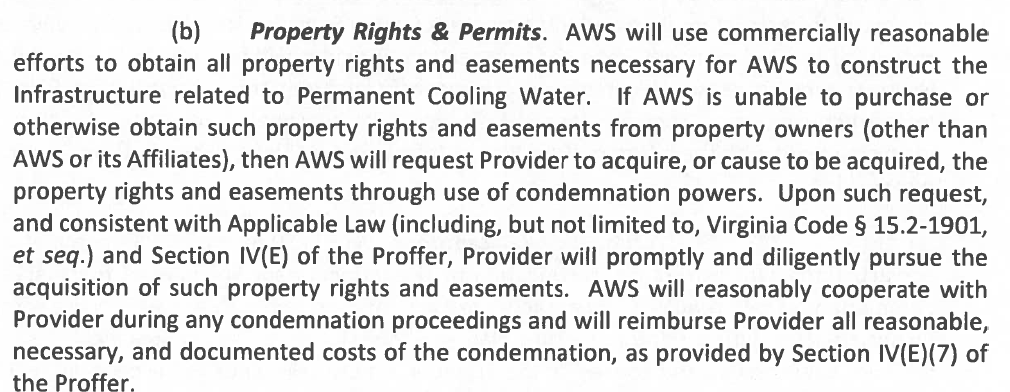
This is a contractual commitment to pursue acquisition under specified conditions. It is not a transfer of eminent domain authority to Amazon, and it does not dispense with the legal requirements for any particular acquisition.
The agreement also does not establish, on its own, which written requests triggered the October 20 actions. Connecting each acquisition to this clause requires the request letters, negotiation records, final resolutions and relevant easement plans.
What an easement means for an owner
Condemnation is the legal process used to exercise eminent domain. It can acquire a limited property right, such as a utility easement, rather than an entire parcel.
An owner may keep title while having to permit installation, access and maintenance within a defined corridor. The actual easement language determines restrictions on buildings, planting and other improvements. Temporary construction easements may impose separate impacts during the work.
That makes the width, location, access terms, restoration requirements and compensation important—not merely the fact that a pipeline is underground.
Public ownership is part of the agreement, too
Describing this solely as a private pipeline leaves out a significant provision. Section 1.1(g), on page 4, provides for Amazon to transfer infrastructure and related property interests to Stafford County after construction, successful testing and satisfaction of the applicable acceptance requirements.
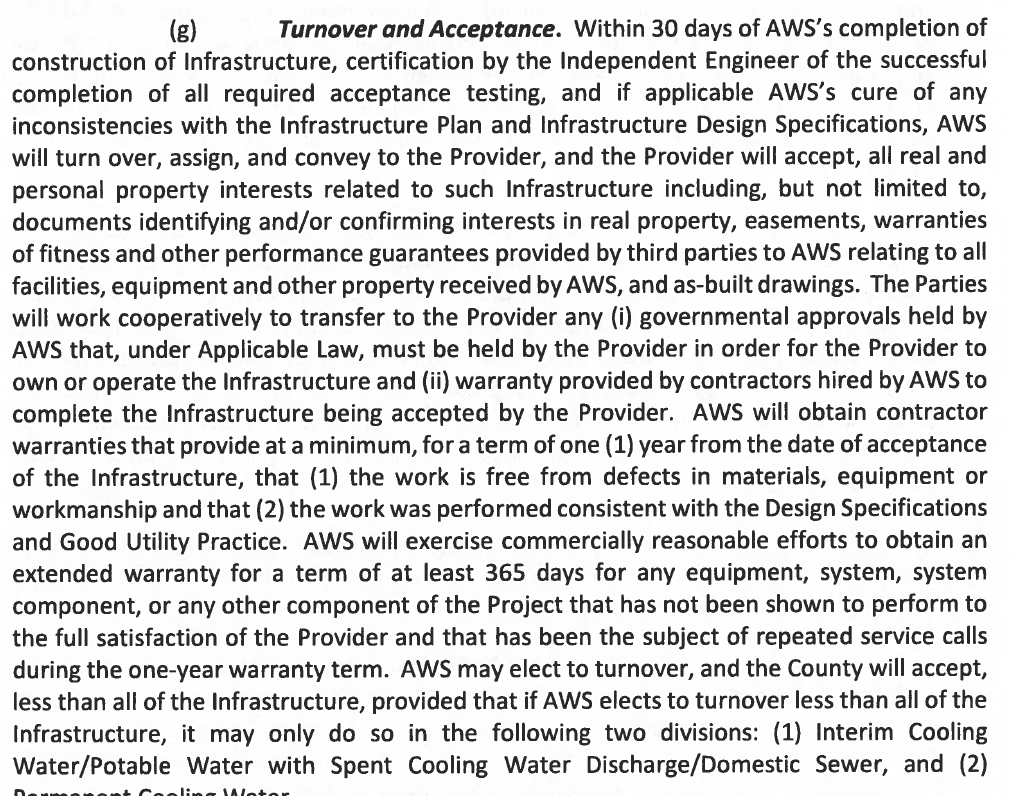
That planned transfer is relevant to the county’s public-utility explanation. It also creates a practical question for residents: what obligations will the county accept when it takes ownership?
Reclaimed-water systems can reduce industrial use of drinking water by supplying treated wastewater for suitable cooling applications. But a potential water-conservation benefit does not, by itself, establish that every proposed easement is necessary or that a particular route is the best available option.
Who pays—and what the agreement does not settle
Section 1.1(d) assigns Amazon the design, construction and testing costs for the infrastructure contemplated by that section. The condemnation clause separately addresses reimbursement under the proffer.

There are additional financial terms worth examining. Section 1.2(b)(v), on page 6, covers specified county design and inspection costs for Aquia treatment-plant improvements. It sets a $14 million threshold requiring Amazon’s prior written consent to exceed, with a process for requesting an increase. The provision also says Amazon will not unreasonably deny the county’s request for a change order.
That $14 million is not identified as the total project budget. It applies to the particular costs described in that provision. It should not be presented as a cap on the entire reclaimed-water system or as proof of a taxpayer shortfall.
Residents still need a consolidated accounting of developer contributions, acquisition costs, financial guarantees, utility charges and future operating expenses. Construction funding and long-term maintenance funding are different questions.
The legal question requires more than a contract
Virginia’s Constitution requires public use, just compensation and limits on the amount of property taken. It also restricts takings whose primary use is private benefit, private enterprise, increased tax revenue, jobs or economic development, while addressing utility-related exceptions.
Virginia Code § 1-219.1 recognizes specified public-facility and utility uses. Subsection D expressly excepts certain government-utility and public water-facility takings from its additional private-benefit restrictions. Subsection K addresses the constitutional treatment of government utilities providing authorized utility service. These provisions are important here: private commercial benefit alone does not establish an unlawful taking. Applying the law to this project requires the actual ownership, service arrangements and acquisition record.
A contract cannot establish legal authority that the county does not otherwise possess. Equally, the presence of private commercial customers does not alone prove an unlawful taking. The public-use justification and necessity for the specific property rights must be evaluated on the complete record.
Six questions the county should answer
- What triggered these acquisitions? Release the developer requests and identify the agreement or proffer supporting each action.
- Why this route and these easements? Publish the alternatives evaluated, corridor dimensions and reasons the selected rights are necessary.
- What negotiations occurred? Explain the offers, appraisals and efforts to resolve disagreements voluntarily, with appropriate protection of exempt information.
- What is the public-use case? Identify the adopted findings and explain who can use the system and on what terms.
- Who bears the full cost? Show developer obligations, security, county commitments and the source of future operating and replacement funds.
- What growth can the system support? Disclose planned capacity, service area and anticipated additional customers. Capacity for future development should not be confused with approval of that development.
A commitment made in 2024 deserves scrutiny in 2026
The agreement establishes that condemnation assistance was contemplated well before the October 20 vote. The latest reporting establishes that supervisors have now authorized acquisition proceedings for the reuse-water system.
The next step is to make the connection between those records transparent: what was requested, what was negotiated, why compulsory acquisition was considered necessary and what responsibilities the public will inherit.
For affected owners, this is about rights to their land. For the wider county, it is about how public authority supports major development—and whether the safeguards, costs and benefits have been fully explained.
Sources and document excerpts
- AWS–Stafford Water and Wastewater Infrastructure Agreement, effective August 22, 2024: cover sheet; §§ 1.1(b), 1.1(d), 1.1(g) and 1.2(b)(v), https://savestafford.org/documents/foia/3462/06-contract-execution-request-stafford-county-final-executive-redacted.pdf pages 1, 3, 4 and 6.
- Jonathan Hunley, Fredericksburg Free Press, October 21, 2026: reporting on the October 20 votes, negotiations and officials’ explanations.
- Stafford County wetlands application 25156872: project description and intended users; this record is not a record of the Board’s condemnation votes.
- Constitution of Virginia, Article I, Section 11.
- Virginia Code § 1-219.1.
Document images are unaltered crops of the linked public-record https://savestafford.org/documents/foia/3462/06-contract-execution-request-stafford-county-final-executive-redacted.pdf. Crops show selected passages, not complete sections; follow the page links for surrounding terms. Vote details and meeting statements are attributed to the Free Press. The official agenda was located, but its download was inaccessible during this review; adopted resolutions and official voting records have not been independently checked. This article does not establish that Amazon submitted a request under Section 1.1(b) for each acquisition, or establish the status of individual court filings or completed acquisitions. Financial provisions describe the supplied 2024 agreement; later amendments, if any, have not been verified.
Help Stafford residents stay informed
Choose a social network, send it by email, or copy the direct link.