Stafford County Board of Supervisors Chairman Deuntay Diggs is taking one of the county’s largest financial challenges directly to the state.
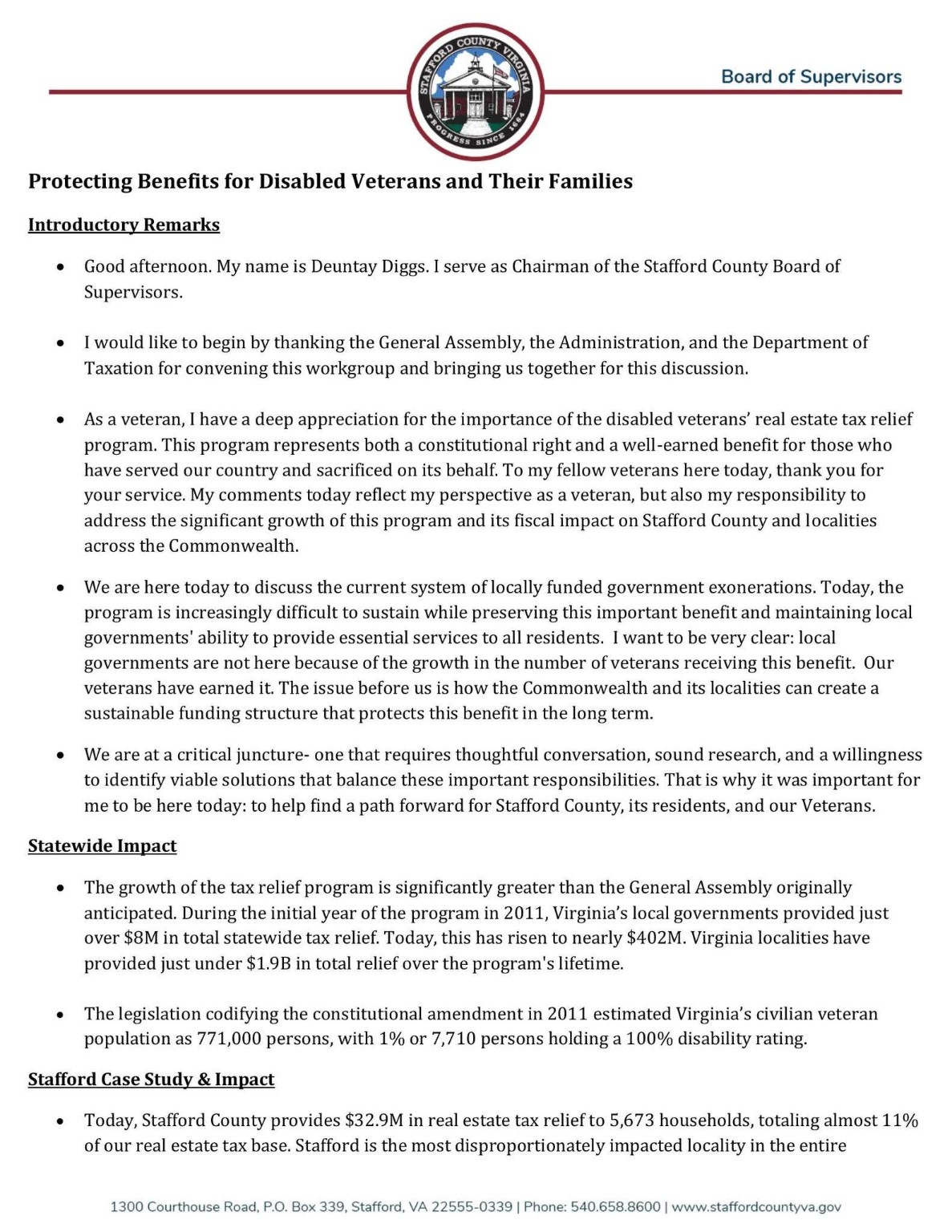
In remarks prepared for Virginia’s Disabled Veteran Property Tax Exemption Work Group, Diggs laid out Stafford County’s case for state assistance, arguing that the county’s rapidly growing disabled veterans real estate tax exemption is becoming increasingly difficult for the local tax base to absorb.
His message was also explicit on another point: the veterans’ benefit itself should be protected.
“As a veteran, I have a deep appreciation for the importance of the disabled veterans’ real estate tax relief program,” Diggs said in the remarks provided to Save Stafford.
Diggs described the exemption as both a constitutional right and an earned benefit. Instead of reducing that benefit, he is asking Virginia to reconsider how its cost is funded.
Why Virginia is examining the issue
This is not simply a Stafford County initiative.
The 2026 Virginia budget directed the Department of Taxation to establish a work group to examine mandatory property tax exemptions for disabled veterans and their spouses. The group is charged with examining the exemption’s cost, its financial impact on local governments, previous legislation and possible recommendations to the General Assembly. Its report is due by November 15, 2026.
The underlying exemption is established in the Virginia Constitution. Qualifying veterans determined to have a 100 percent service connected, permanent and total disability are exempt from real property taxation on their principal residence, subject to requirements established by law. Certain surviving spouses also qualify.
That means local governments such as Stafford must provide the exemption even though real estate taxes are one of their primary sources of local revenue.
Stafford says it is being hit especially hard
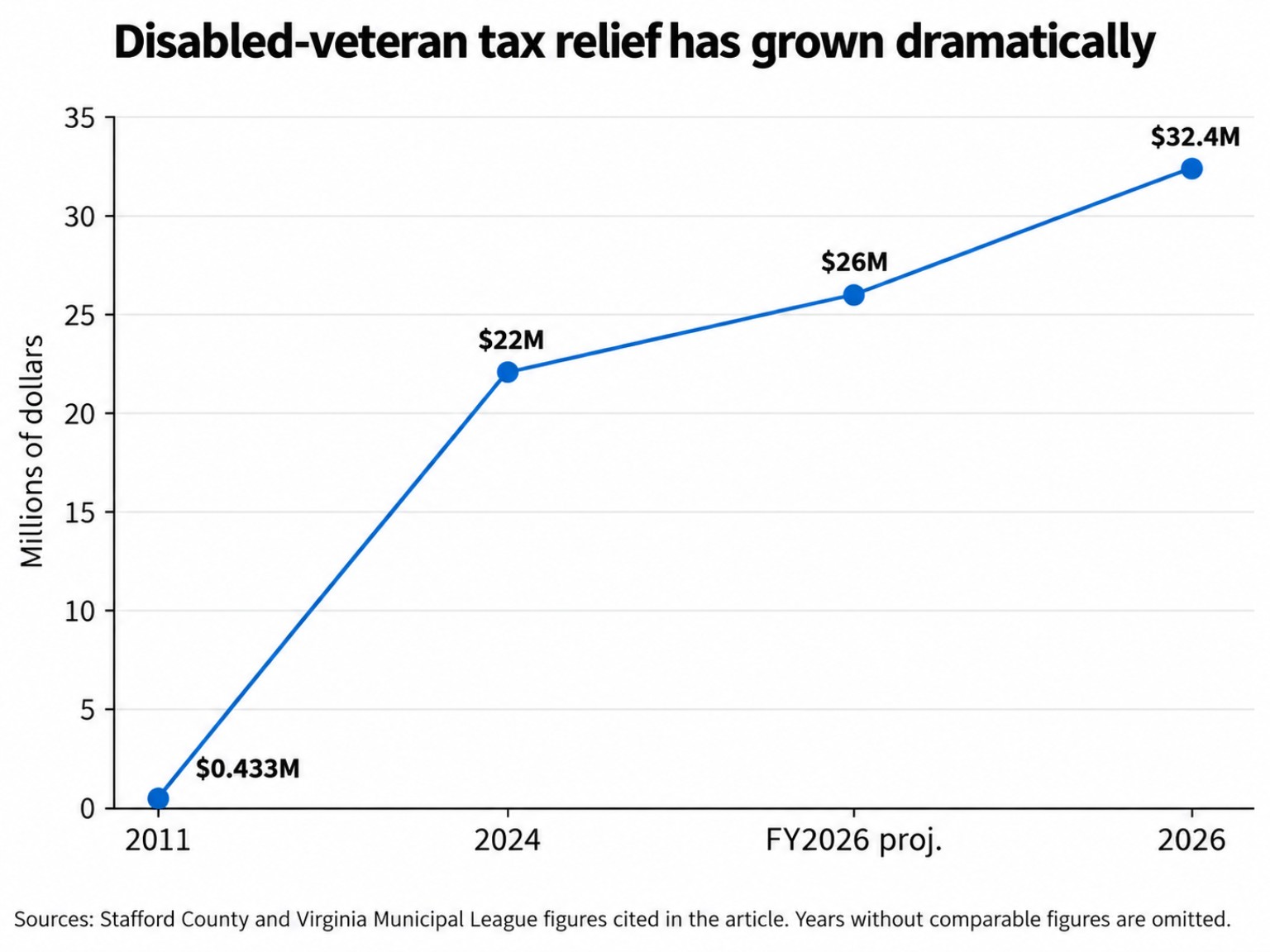
According to Diggs’ presentation, Stafford currently provides approximately $32.9 million in real estate tax relief to 5,673 households. The county says that represents almost 11 percent of its real estate tax base.
Diggs also told the work group that Stafford has provided approximately $141 million in relief since the program began in 2011.
The county projects that annual relief could reach approximately $100 million per year, with cumulative relief exceeding $934 million by FY2034.
Those are Stafford County projections presented by Diggs, not figures independently established by the state work group. The work group’s purpose is, in part, to examine the underlying costs and fiscal effects statewide.
Stafford’s unusual position
Diggs’ presentation argues that Stafford is affected far more heavily than its population alone would suggest.
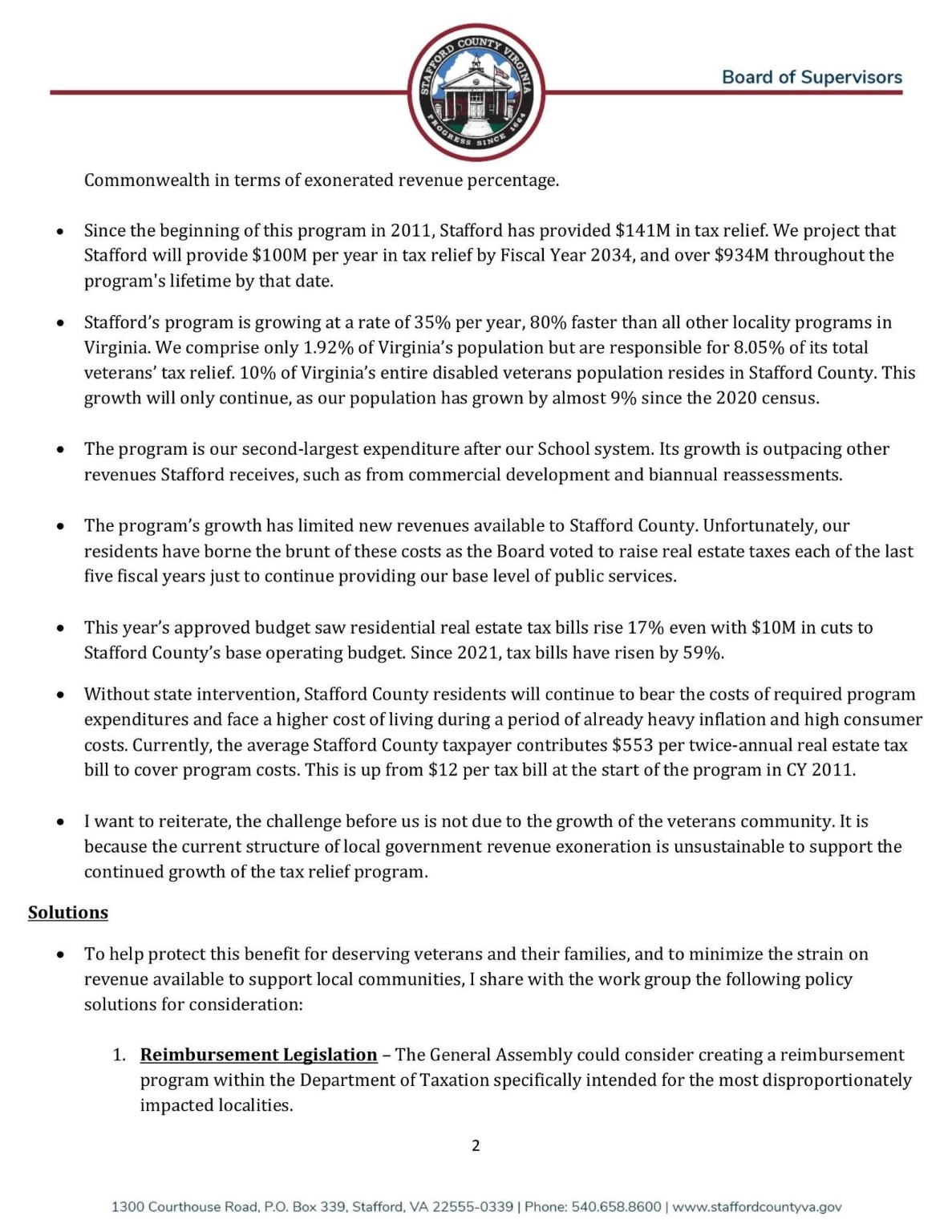
Diggs characterized Stafford as the Virginia locality most disproportionately affected when the exemption is measured as a percentage of local real estate revenue.
According to his presentation, Virginia local governments provided just over $8 million in relief during the program’s first year in 2011. He said that figure has grown to nearly $402 million annually, with just under $1.9 billion provided over the program’s lifetime.
Diggs connects the issue to Stafford tax bills
Diggs also made a broader argument about what happens when millions of dollars of property value become exempt from taxation.
The county still has to operate schools, public safety, transportation and other services. If one portion of the property tax base becomes exempt, officials must reduce expenditures, find revenue elsewhere or collect more from the remaining tax base.
In his remarks, Diggs said Stafford’s residential real estate tax bills increased 17 percent under this year’s approved budget and 59 percent since 2021. He argued that the increasing exemption has reduced the amount of new revenue available for other county responsibilities.
The presentation estimates that an average Stafford taxpayer now contributes approximately $553 on each twice annual real estate tax bill toward replacing revenue associated with the program, compared with approximately $12 per bill when the program began.
That does not mean the veterans exemption alone caused Stafford’s property tax increases. Property tax bills are affected by assessments, tax rates, spending decisions, population growth, school funding, capital requirements and other factors.
Diggs’ argument to Richmond is that the exemption has become large enough to materially affect Stafford’s overall financial position.
Diggs is not asking to eliminate the benefit
That distinction is important.
Diggs repeatedly stated that the problem, in his view, is not the veterans receiving the exemption. His concern is the funding mechanism.
The exemption is mandated by Virginia, while much of the resulting reduction in property tax revenue is absorbed at the local level.
If Virginia requires the benefit, should Virginia help communities carrying unusually large portions of its cost?
Two solutions proposed for Stafford
Diggs presented two potential approaches.
The first is state reimbursement legislation. Under that concept, the General Assembly could establish a reimbursement program through the Virginia Department of Taxation for localities disproportionately affected by mandatory veterans property tax exemptions.
That could allow the benefit to remain intact while shifting some of the financial impact from Stafford taxpayers to the state.
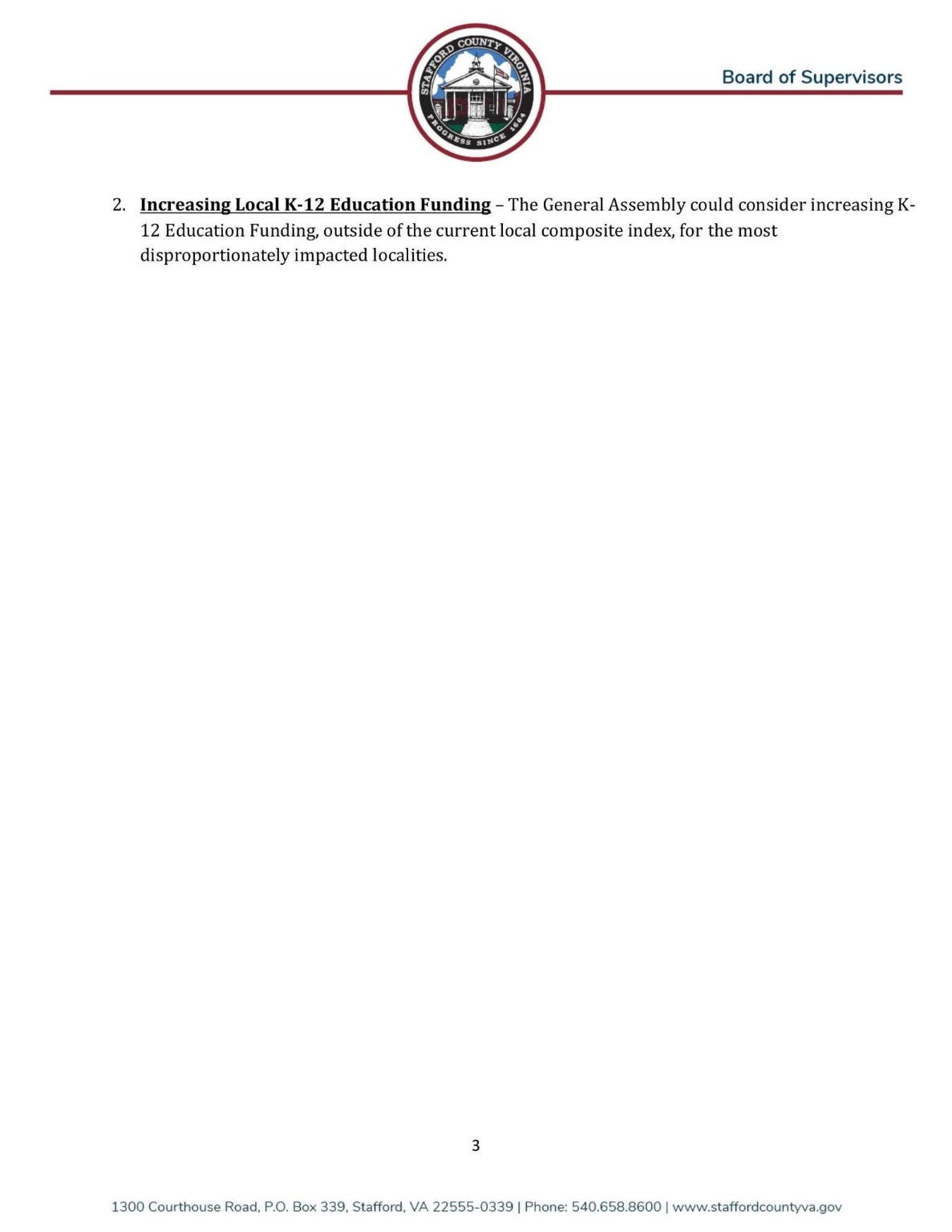
His second proposal involves additional state funding for K–12 education. Diggs suggested Virginia could provide additional education funding, outside the existing Local Composite Index calculation, to disproportionately affected communities.
That would not directly reimburse each veterans exemption. Instead, additional state education funding could reduce the amount of local revenue Stafford must dedicate to schools, potentially offsetting some of the revenue lost through the exemption.
Stafford is making its case while Virginia is listening
The timing matters. Virginia has acknowledged that the growing cost of mandatory veterans property tax exemptions warrants statewide examination. The Department of Taxation work group must make recommendations to key General Assembly committees by November 15.
That gives Stafford an opportunity to put its numbers directly into the discussion before lawmakers consider what, if anything, should change.
Diggs is using that opportunity to argue for Stafford.
The position presented by Stafford’s chairman is clear: Protect the exemption. Protect the veterans who earned it. But do not require communities such as Stafford to shoulder a disproportionate share of a statewide benefit without additional state assistance.
For Stafford taxpayers, the outcome of that discussion could have consequences well beyond the veterans exemption itself. If the county’s projections prove accurate, finding a sustainable way to finance the program could become an increasingly important part of Stafford’s long term budget debate.
Sources, documents & image credits
Read the original record
Chairman Deuntay Diggs — prepared remarks, page 1Provided to Save Stafford · September 2026 · Open original source ↗Chairman Deuntay Diggs — prepared remarks, page 2Provided to Save Stafford · September 2026 · Open original source ↗Chairman Deuntay Diggs — prepared remarks, page 3Provided to Save Stafford · September 2026 · Open original source ↗Constitution of Virginia — Article X, Section 6-ADisabled veterans and surviving spouses real property tax exemption · Open original source ↗Virginia Department of Taxation — Property Tax and Real Estate Tax QuestionsState overview of locally administered real property taxation · Open original source ↗Compare the financial stage, linked public documents and outstanding verification gaps.
View financial record →Support Save Stafford
Independent local information. No paywalls. No advertising.Research like this takes time and sometimes requires obtaining public records. Community support helps Save Stafford continue making this information freely available.
No subscription required. Contribute only if you choose. Financial contributions do not purchase editorial influence.