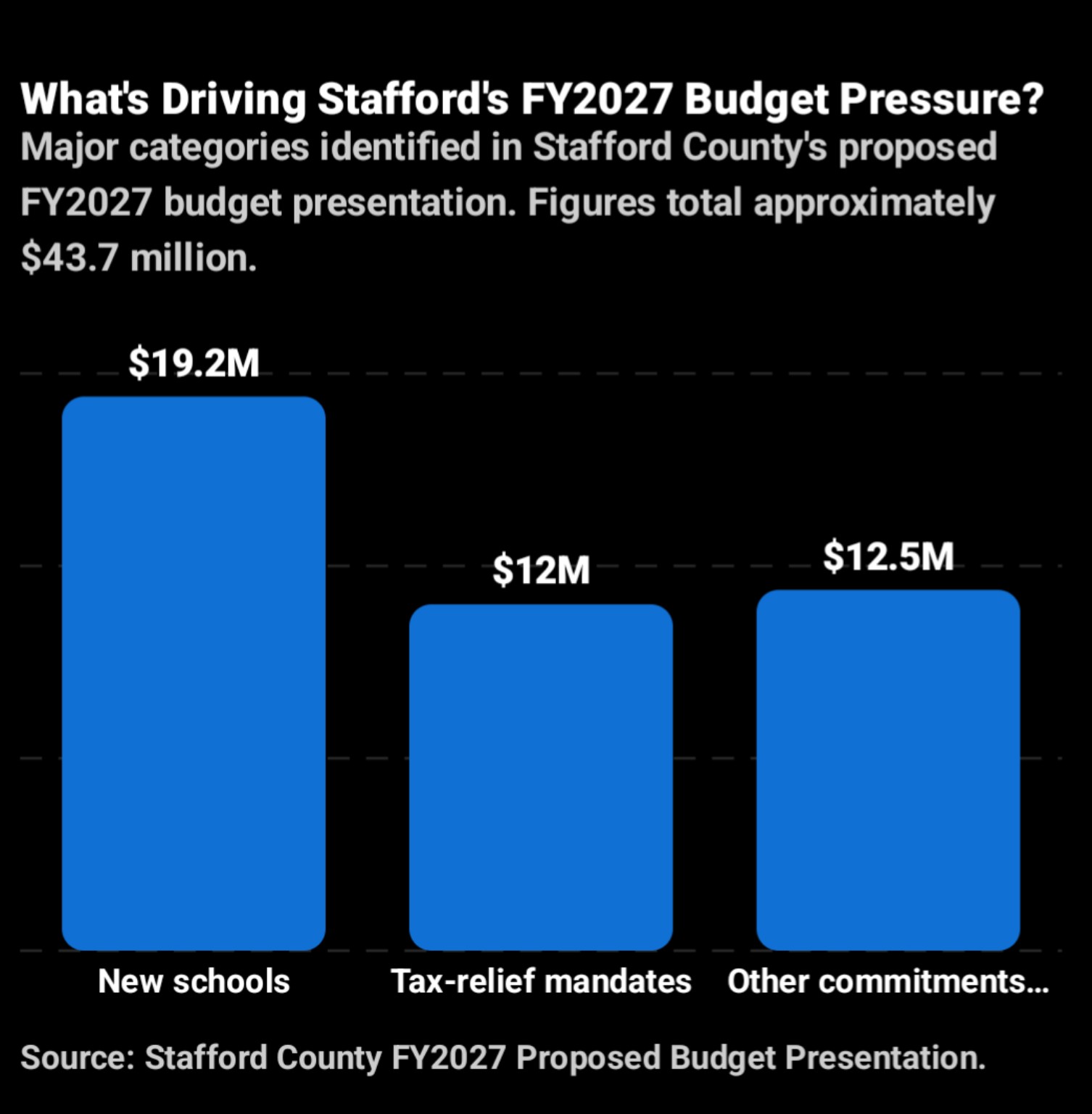
Stafford County entered the FY2027 budget process facing nearly $44 million in additional baseline funding requirements. County officials identify education, public safety, tax-relief mandates, new-school costs and inflation among the pressures.
But before taxpayers are asked to provide more money, they have every right to examine how much government spending has already increased.
One category stands out: personnel.
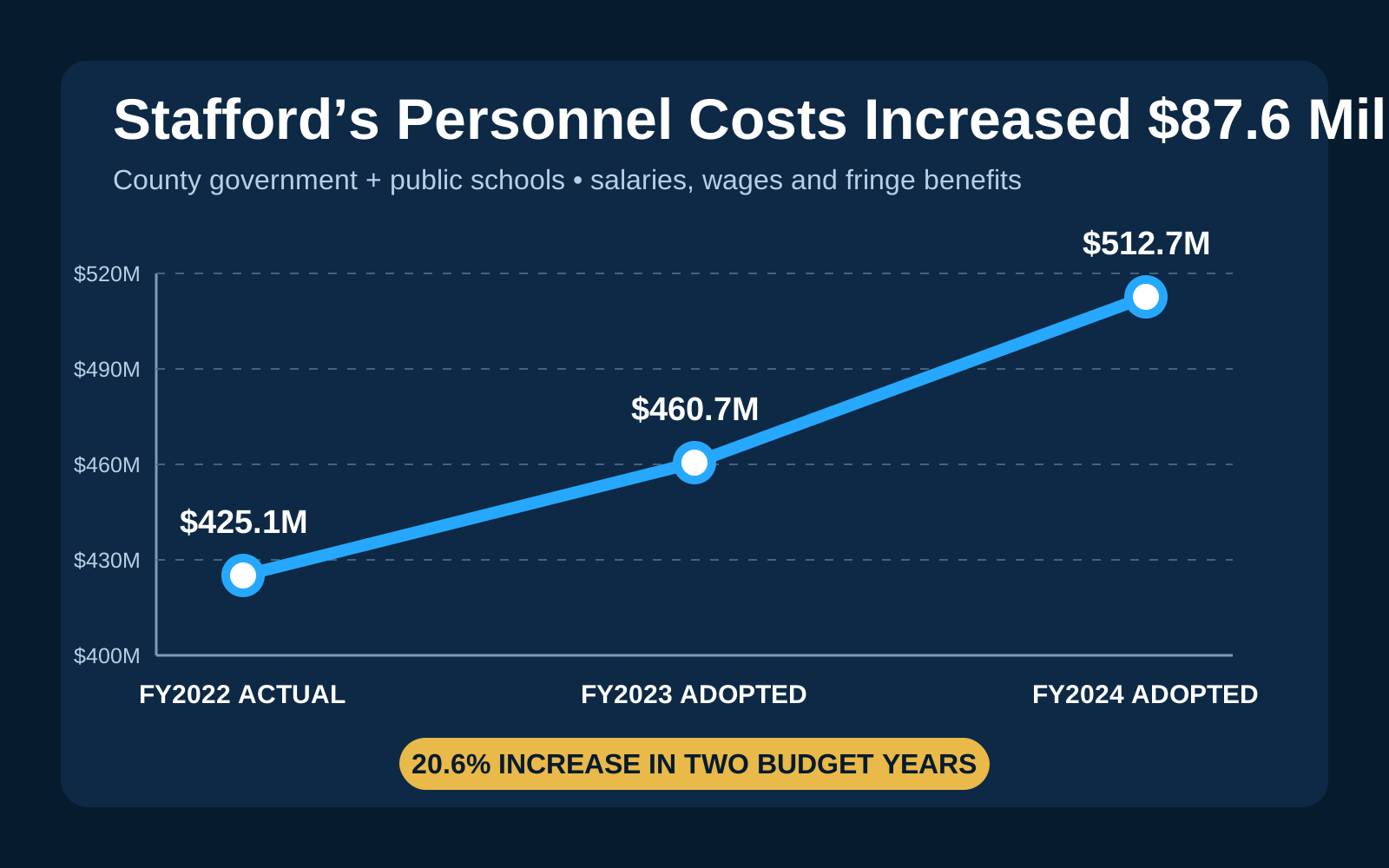
Stafford’s official budget records show personnel costs rising from approximately $425.1 million in FY2022 actual expenditures to $512.7 million in the FY2024 adopted budget.
The figures cover personnel expenses across Stafford’s funds, including County government and Stafford County Public Schools. Stafford defines personnel costs as expenses associated with compensating employees, including salaries, wages and fringe benefits.
The numbers do not prove that every increase was unnecessary. But an $87.6 million increase in two budget years is too large to exclude from the discussion about Stafford’s affordability.
The increase happened in two major steps
From the FY2023 adopted budget to the FY2024 adopted budget alone, personnel costs increased approximately 11.3%. Compared with FY2022 actual spending, the FY2024 adopted personnel budget was approximately 20.6% higher.
That growth deserves a complete public explanation. How much came from salary increases, additional teachers and school employees, new County positions, public-safety compensation, overtime, health insurance, retirement contributions or staffing for new facilities?
The broad personnel category does not provide those answers by itself. It does establish the scale of the increase.
The increase was twice the size of Stafford’s current baseline problem
Stafford began developing its FY2027 budget with nearly $44 million in additional baseline requirements. The increase between FY2022 actual personnel spending and the FY2024 adopted personnel budget was approximately $87.6 million—about twice as large.
This comparison places an actual expenditure beside a later adopted budget. It does not mean Stafford overspent by $87.6 million or that the entire increase can simply be reversed. It shows that the County planned a major expansion of personnel spending while its broader budget pressures were accumulating.
Inflation explains only part of the increase
Inflation increased the cost of wages, health insurance and other employee benefits during this period. But a 20.6% personnel increase in two budget years cannot be understood through inflation alone without a detailed reconciliation.
Some of the increase may reflect legitimate needs: competitive salary adjustments, teacher compensation, public-safety recruitment, population growth, new facilities, health-insurance costs and retirement contributions.
Necessary spending is still spending. Each permanent position, salary adjustment and employer-paid benefit becomes part of Stafford’s recurring cost structure.
Stafford continued increasing compensation
The FY2026 budget provided a 2.75% pay increase for public-safety and general-government employees. The proposed FY2027 budget includes a 4% compensation adjustment across general government and public safety, $300,000 in targeted adjustments for Fire & Rescue and the Sheriff’s Office, and approximately $1.6 million in additional employer health-insurance contributions. It also includes funding for school employee compensation.
Stafford says these investments are needed to remain competitive and retain qualified employees. That may be true. It also means the recurring cost of the workforce continues to rise while taxpayers face additional demands.
A separate County payroll measure also increased
Stafford’s audited Virginia Retirement System schedule reports County VRS-covered payroll rising from approximately $70.5 million in FY2022 to $94.6 million in FY2025—an increase of approximately $24.1 million, or 34.1%.
This is not Stafford’s complete payroll or total personnel expense. It covers compensation included in the applicable retirement-system schedule and does not replace the broader $512.7 million personnel figure. It is another official indicator showing that the cost base associated with Stafford’s County workforce increased substantially.
Could Stafford reverse some of the growth?
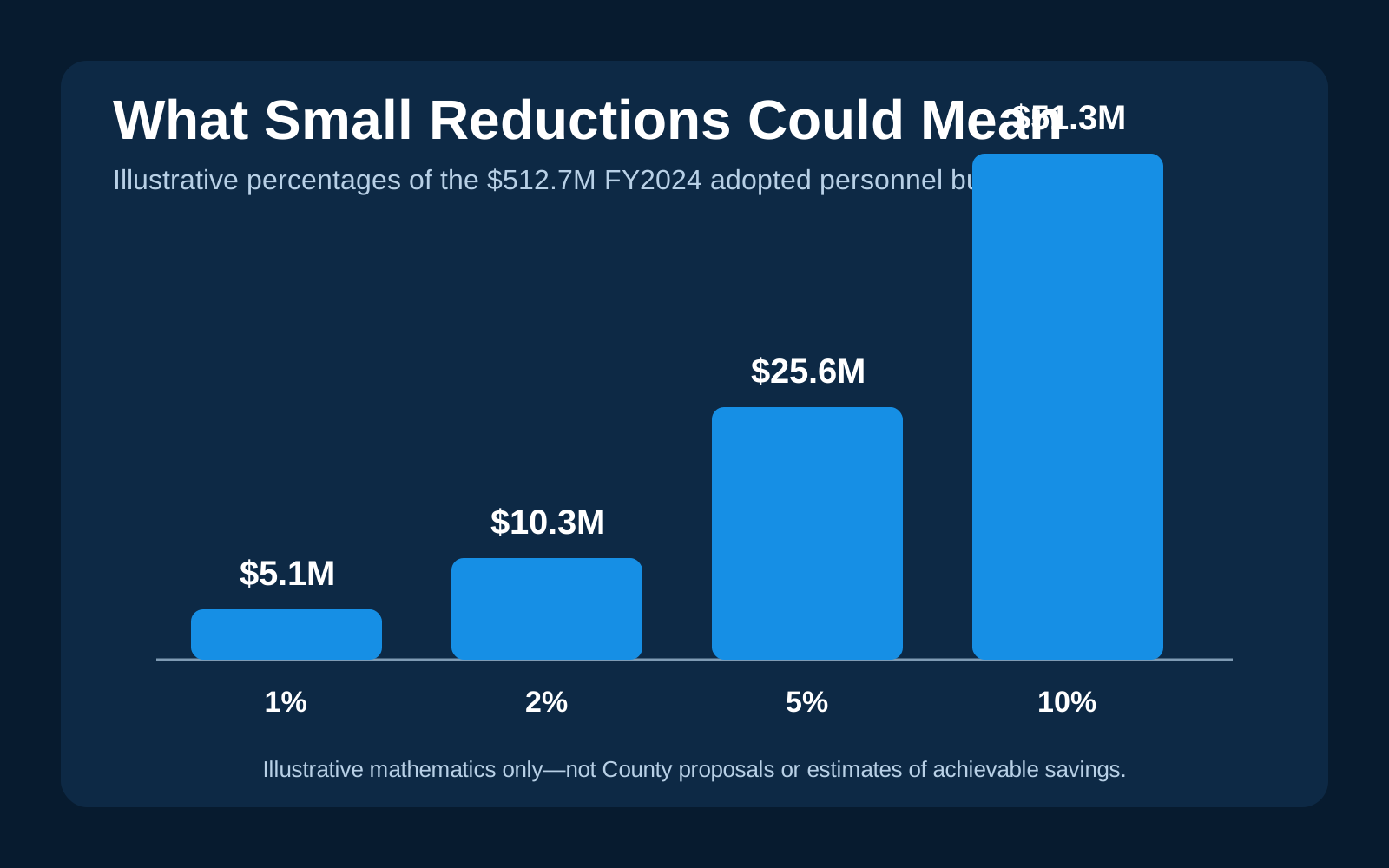
If Stafford reduced total personnel spending from the FY2024 adopted level, even small percentages would represent millions of dollars:
These are mathematical illustrations—not County proposals, forecasts or estimates of readily available savings.
They also are not estimates of salary cuts. The $512.7 million figure includes salaries, wages and fringe benefits. A 5% salary reduction would not automatically reduce the entire personnel category by 5%, because expenses such as health insurance might remain largely unchanged.
What would it take to return to the FY2022 level?
Returning the FY2024 adopted personnel budget to FY2022 actual spending would require approximately $87.6 million in reductions, equal to about 17.1% of the FY2024 personnel budget.
A reduction of that size would not be a minor efficiency measure. It could require some combination of major salary reductions, position eliminations, larger class sizes, reduced public-safety staffing, benefit changes and significant reductions in school and County services.
But Stafford does not have to eliminate the entire increase for personnel controls to matter. Recovering even one-quarter of the $87.6 million increase would represent approximately $21.9 million—roughly half of the nearly $44 million FY2027 baseline increase.
That is an illustration, not a finding that $21.9 million can be removed without unacceptable consequences. It shows why the growth deserves close examination.
Salary cuts are only one option
There are two different questions: Should Stafford pay each employee less? And does Stafford need every position and personnel expense it currently funds?
Reducing every employee’s salary would spread the financial impact across teachers, deputies, firefighters, inspectors, social-services employees and administrative workers. A more targeted review could focus on vacancies, management consolidation, overtime, duplicate functions, positions added faster than population or enrollment, benefit design, future hiring and future compensation increases.
That approach could reduce spending without assuming that every employee is overpaid.
Stafford has already found personnel-related savings
During preparation of the FY2026 budget, Stafford identified approximately $4 million in reductions from its FY2025 spending base.
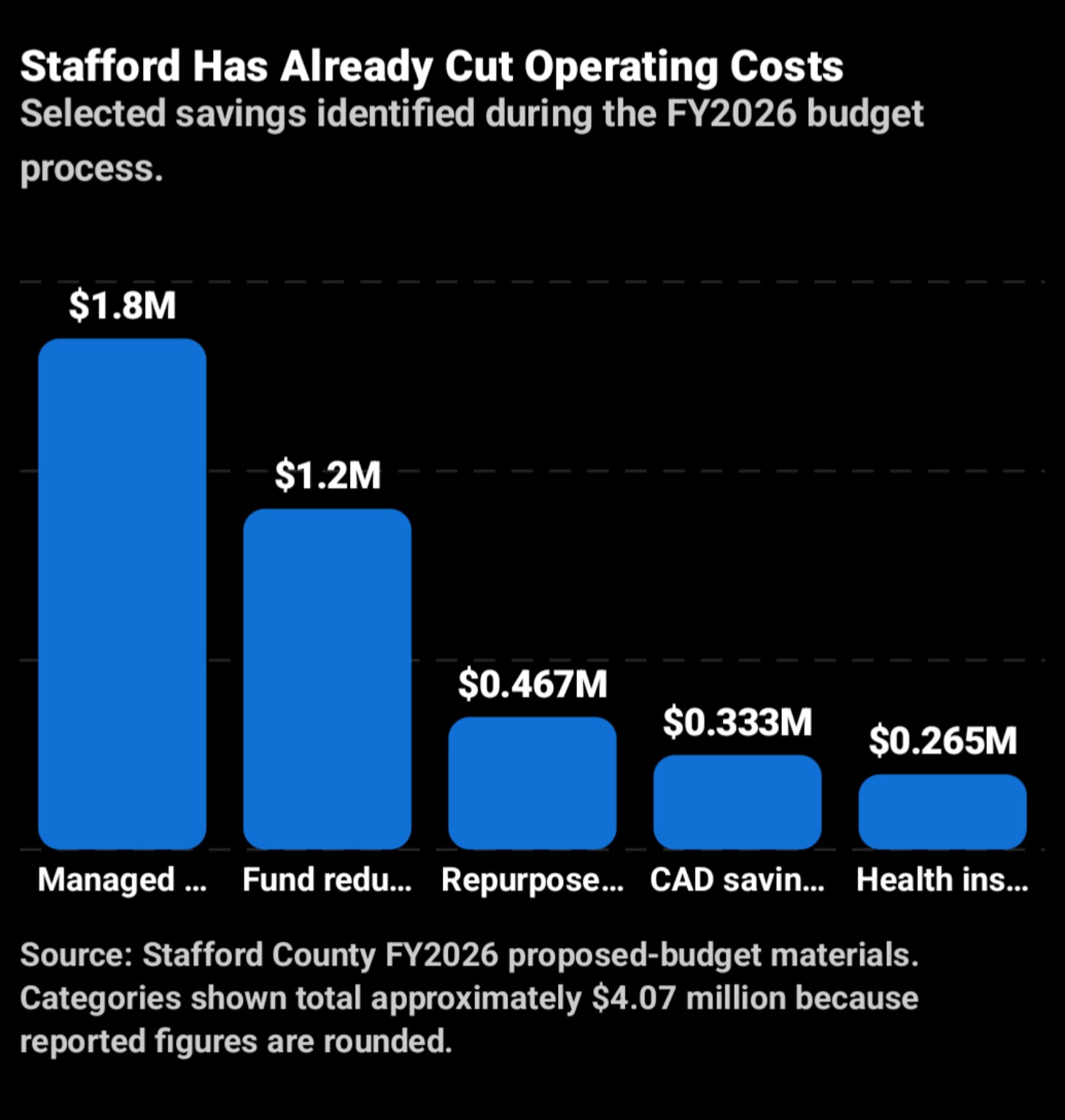
These savings demonstrate that personnel and operating expenses can be reduced without cutting every employee’s salary. They also show the difference in scale: $4 million is meaningful, but it is less than 5% of the $87.6 million increase.
Growth and new facilities matter
Stafford’s population and public-service demands have increased. The County has added schools, public-safety capacity and facilities that require employees to operate them. A larger personnel budget is therefore not automatic evidence of waste.
But growth alone does not establish that a 20.6% increase was justified. Stafford should show employee growth compared with population, school staffing compared with enrollment, compensation growth after inflation, the departments responsible for the largest increases, overtime trends, vacancy totals and the service improvements produced by the additional spending.
Stafford should reconcile the full $87.6 million increase
For every major component, Stafford should identify whether it involved County government or public schools, whether it resulted from more employees or higher compensation, how much came from salaries and benefits, whether the cost is temporary or recurring, and what service taxpayers received in return.
The County should also publish specific reduction scenarios showing what it would take to reduce annual personnel expenses by $5 million, $10 million, $20 million and $25 million—including the positions, services, compensation or benefits affected.
The bottom line
Stafford’s personnel category increased from $425.1 million in FY2022 actual spending to a $512.7 million FY2024 adopted budget. That is approximately $87.6 million—or 20.6%.
Not every dollar was necessarily avoidable. Stafford grew, opened facilities, adjusted compensation and faced higher insurance and benefit expenses. But the increase is too large to treat as a side issue.
Stafford cannot credibly discuss a nearly $44 million baseline increase without closely examining a personnel category that grew by approximately $87.6 million in two budget years.
Where did the additional $87.6 million go—and does every recurring dollar still need to be spent?
The answer may not be widespread layoffs or across-the-board salary reductions. It may involve vacancies, consolidation, slower hiring, overtime controls, benefit reforms, administrative reductions and greater scrutiny of future compensation increases.
Stafford’s budget problem is bigger than payroll. But payroll growth is too large to ignore.
Sources, documents & image credits
Read the original record
Stafford County FY2024 Adopted BudgetOfficial all-funds personnel totals and definition · Open original source ↗Stafford County — Annual Comprehensive Financial ReportsAudited VRS-covered-payroll schedules · Open original source ↗Stafford County FY2024 Annual Comprehensive Financial ReportOfficial audited financial statement · Open original source ↗Stafford County FY2023 Annual Comprehensive Financial ReportOfficial audited historical cross-check · Open original source ↗Stafford County — Budget and Capital Improvement ProgramFY2027 proposed budget and historical adopted budgets · Open original source ↗Stafford County FY2027 proposed-budget presentationBaseline funding needs and major budget pressures · Open original source ↗Stafford County FY2026 proposed-budget materialsBase-budget reductions and managed vacancy savings · Open original source ↗Stafford County FY2024 adopted budgetCompensation changes and Sheriff’s Office funded positions · Open original source ↗Compare the financial stage, linked public documents and outstanding verification gaps.
View financial record →Support Save Stafford
Independent local information. No paywalls. No advertising.Research like this takes time and sometimes requires obtaining public records. Community support helps Save Stafford continue making this information freely available.
No subscription required. Contribute only if you choose. Financial contributions do not purchase editorial influence.