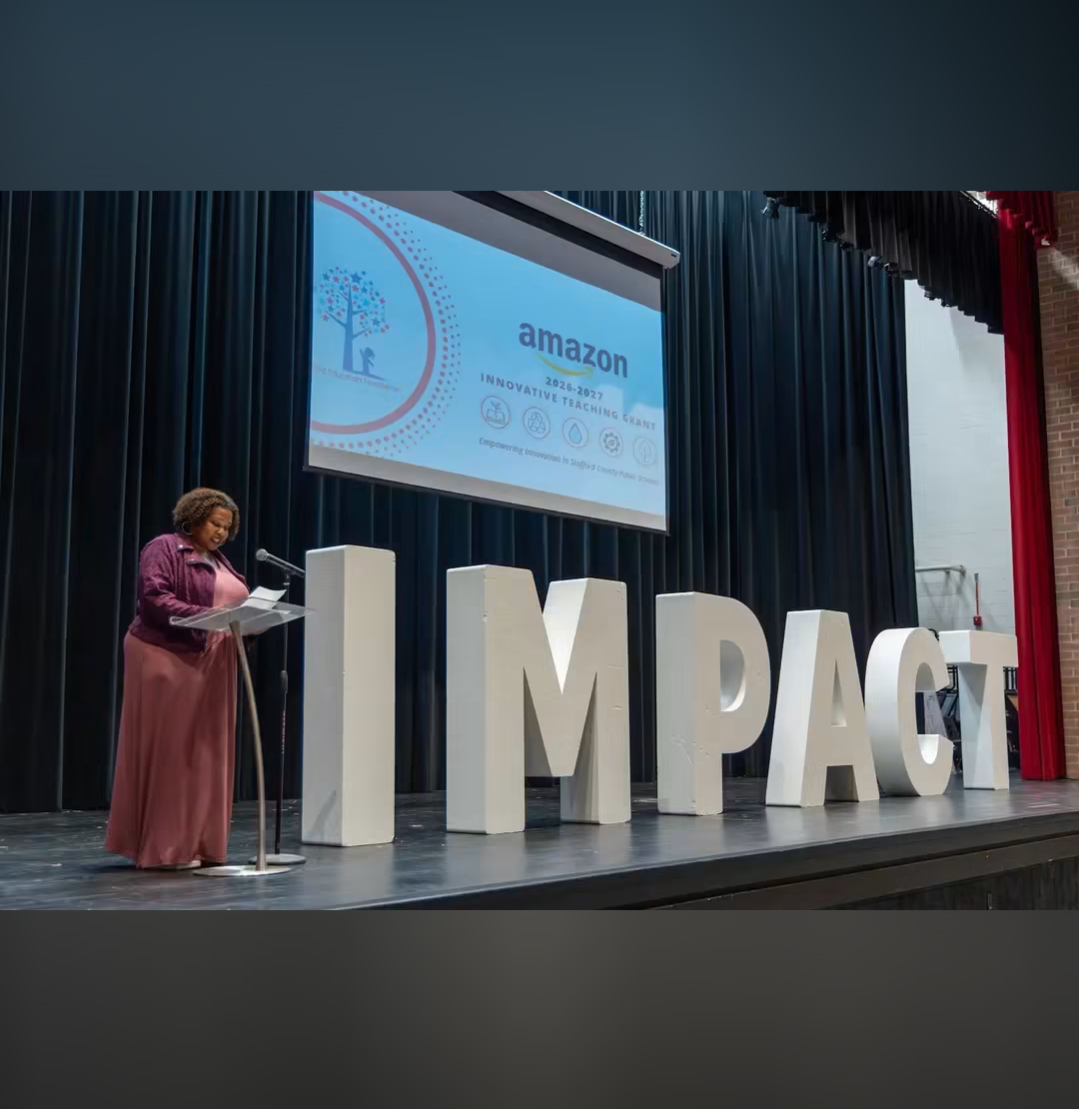
Amazon is funding classroom projects and food access in Stafford County. Its cloud-computing business is also helping finance infrastructure that will support a substantial data-center presence.
How substantial?
Amazon’s own reclaimed-water portfolio lists 21 contracted data-center locations in Stafford County.
That statement comes directly from Amazon, not from opponents of data centers. It connects the company’s Stafford expansion to a water system that county officials expect AWS and STACK Infrastructure to use extensively.
None of these facts establishes that Amazon purchased a vote or government approval. The records reviewed for this article do not establish that community contributions were exchanged for favorable government action.
They do raise a public-policy question: How does Stafford protect independent decision-making as Amazon becomes an increasingly important infrastructure partner, utility customer, prospective taxpayer and community benefactor?
Amazon’s own document identifies 21 contracted locations
Amazon’s May 2026 Reclaimed Water Project Portfolio includes a section labeled “Stafford County, Virginia, USA.”
On printed page 10, the company lists:
“Data center locations contracted” — 21.
The same section says AWS is funding wastewater-treatment-plant upgrades and pipeline extensions to its Stafford locations. Amazon expects those locations to use reclaimed water once fully operational, preserving potable water for community use.
Read or download Amazon’s original PDF. See printed pages 10–11.
The terminology matters. Twenty-one contracted locations does not necessarily mean 21 campuses, 21 completed buildings or 21 operating data centers.
The portfolio’s summary table on printed page 11 lists Stafford with 21 contracted locations and zero operating locations within the reclaimed-water portfolio. That table should not be interpreted as a count of all operating data centers in Stafford.
What the document establishes is significant enough: Amazon reports a reclaimed-water arrangement covering 21 Stafford data-center locations.
More than $300 million in water infrastructure
Amazon separately says that, in partnership with STACK Infrastructure, it is investing more than $300 million to upgrade the Aquia Wastewater Treatment Plant, pump stations and related infrastructure supporting Stafford’s new water-reuse system.
The company describes the system as a way to use treated wastewater for data-center cooling and reduce demand on drinking-water supplies.
Read Amazon’s description of the Stafford infrastructure investment.
That is a meaningful potential benefit. Replacing potable water with reclaimed water can preserve drinking-water capacity.
It is also infrastructure closely connected to the needs of large industrial customers. Residents deserve to understand both aspects of the project: the public benefit and the development it enables.
County officials expected AWS and STACK to use most of the capacity
The connection was discussed publicly at Stafford’s July 23, 2025 Planning Commission meeting.
Chairman Steven Apicella asked what percentage of the Aquia reclaimed-water capacity would be used by AWS and STACK after the reclamation project was completed.
County representative Mr. Edwards responded that they would probably use between 90 and 100 percent.
That was an expectation expressed at the meeting, not a guarantee of actual future consumption or a finding that other customers would be prohibited from connecting.
The discussion also addressed the relationship between temporary potable-water use and the transition to reclaimed water.
Amazon says the infrastructure will position Stafford to serve future reclaimed-water customers. The county discussion nevertheless shows how strongly the initial system is tied to AWS and STACK.
A system can provide public benefits while being built primarily to meet particular companies’ needs. The public should be able to see how that arrangement works.
Amazon’s relationship now reaches Stafford classrooms
Amazon’s presence extends beyond utility infrastructure and industrial development.
On October 1, 2026, the Stafford Education Foundation, Amazon and Stafford County Public Schools celebrated the first year of their Sustainable Innovative Teaching Grants partnership, recognizing 24 projects.
The awards are part of a previously announced $560,000 contribution supporting classroom innovation and food access:
| Program | Announced funding |
|---|---|
| Sustainable Innovative Teaching Grants over three years | $360,000 |
| Expanded food access through automated community kiosks | $200,000 |
| Total | $560,000 |
These programs can provide practical help to teachers, students and families.
They also give Amazon a visible community role while its data-center business is expanding in Stafford.
Read the October report on the 24 teaching grants.
Read the original announcement of the $560,000 contribution.
The financial relationship is much larger than the donations
Stafford’s own financial disclosure describes an incentive agreement with Amazon Data Services, Inc. requiring a minimum $6 billion capital investment and $392 million in infrastructure to the county through 2050.
That description appears on PDF page 52 of the county’s 2026 preliminary school-bond offering document. Read or download the disclosure.
These are agreement commitments described by the county. They should not be presented as money already spent, tax revenue already collected or unrestricted cash available for county services.
The Stafford Economic Development Authority’s 2025 Year in Review also describes its role in the AWS investment arrangement. Its February 2024 agenda package contains records concerning a performance agreement involving the EDA, Stafford County and AWS.
Read or download the Stafford EDA’s 2025 Year in Review.
Read or download the February 2024 EDA agenda package.
The financial distinctions matter. Capital investment, utility construction, tax incentives and charitable contributions serve different purposes.
The $300 million infrastructure announcement and the county’s $392 million infrastructure figure may describe overlapping obligations or different scopes. They should not be added together without reconciling the underlying agreements.
Likewise, billions in private investment do not automatically translate into billions in public benefit. Residents need to understand the taxes collected, reimbursements provided, public obligations assumed and costs that remain with the county.
Is Amazon buying influence?
The documents establish an extensive relationship. They do not establish corruption.
Funding classroom projects, supporting food access and financing infrastructure can benefit a community. Those activities can also build goodwill and strengthen a company’s public standing.
That possibility deserves scrutiny without being presented as proof of a purchased decision.
The concern is how a county evaluates future requests from a company whose investments increasingly shape its infrastructure and financial expectations.
Stafford should be able to assess each rezoning, permit, utility agreement and incentive on its merits. Residents should be able to follow that process even when the applicant is also a valued community partner.
What residents should be able to see
A transparent relationship would give residents clear answers to several questions:
- What are the 21 contracted locations? Which campuses or facilities do they represent, and what is each location’s development status?
- What does Amazon receive under the incentive agreements? What reimbursements apply, what conditions must be met and what happens if commitments are not fulfilled?
- Who pays for the water system over its full life? Construction funding is only one part of the cost. Operations, energy, maintenance and eventual replacement also matter.
- How much potable water can be used before reclaimed water is available? What limits, deadlines and enforcement provisions apply?
- How are community contributions documented? Residents should be able to distinguish charitable support from contractual infrastructure obligations and economic-development incentives.
These questions give residents a way to evaluate the arrangement beyond promotional announcements or projected investment totals.
A relationship that deserves a full public accounting
Amazon’s school and food-access contributions can help Stafford families. Its reclaimed-water investment can reduce demand on potable supplies. Its data-center investment may generate substantial economic activity and tax revenue.
Those benefits deserve consideration alongside the obligations, incentives and long-term risks.
Amazon’s own documentation identifies 21 contracted Stafford data-center locations associated with its reclaimed-water program. County records show that AWS and STACK are expected to be major users of the resulting system.
At that scale, Stafford needs a clear public accounting of the relationship: what the companies fund, what they receive, what the county commits to and how future decisions remain independent.
Community generosity should be recognized. Government agreements should be open to scrutiny. Stafford residents deserve both.
Direct PDF sources
- Amazon Sustainability: Reclaimed Water Project Portfolio
May 2026. Printed page 10 identifies 21 contracted Stafford locations and describes AWS-funded plant upgrades and pipeline extensions. Printed page 11 provides the portfolio’s contracted and operating totals.
- Stafford Planning Commission minutes: July 23, 2025
Printed pages 32–33 discuss expected AWS and STACK use of reclaimed-water capacity.
- Stafford EDA: 2025 Year in Review
The EDA’s account of its role in the AWS investment arrangement.
- Stafford EDA: February 2024 agenda package
EDA records concerning the AWS performance agreement.
- Stafford 2026 preliminary school-bond offering document
PDF page 52 describes minimum capital investment and infrastructure commitments.
These links open PDFs, which readers can save or download from their browser.
Sources, documents & image credits
Read the original record
Amazon Sustainability: Reclaimed Water Project Portfolio — original PDFMay 2026; printed pages 10–11 · Open original source ↗Stafford Planning Commission minutes — original PDFJuly 23, 2025; printed pages 32–33 · Open original source ↗Stafford EDA: 2025 Year in Review — PDFFY 2025 · Open original source ↗Stafford EDA: February 2024 agenda package — PDFFebruary 2024 · Open original source ↗Stafford 2026 preliminary school-bond offering document — PDF2026; PDF page 52 · Open original source ↗Amazon: Stafford water infrastructure investmentCompany account; reviewed October 4, 2026 · Open original source ↗Potomac Local: 24 Stafford teaching grantsOctober 2, 2026 · Open original source ↗Fredericksburg Free Press: $560,000 contributionMay 5, 2026 · Open original source ↗Support Save Stafford
Independent local information. No paywalls. No advertising.Research like this takes time and sometimes requires obtaining public records. Community support helps Save Stafford continue making this information freely available.
No subscription required. Contribute only if you choose. Financial contributions do not purchase editorial influence.