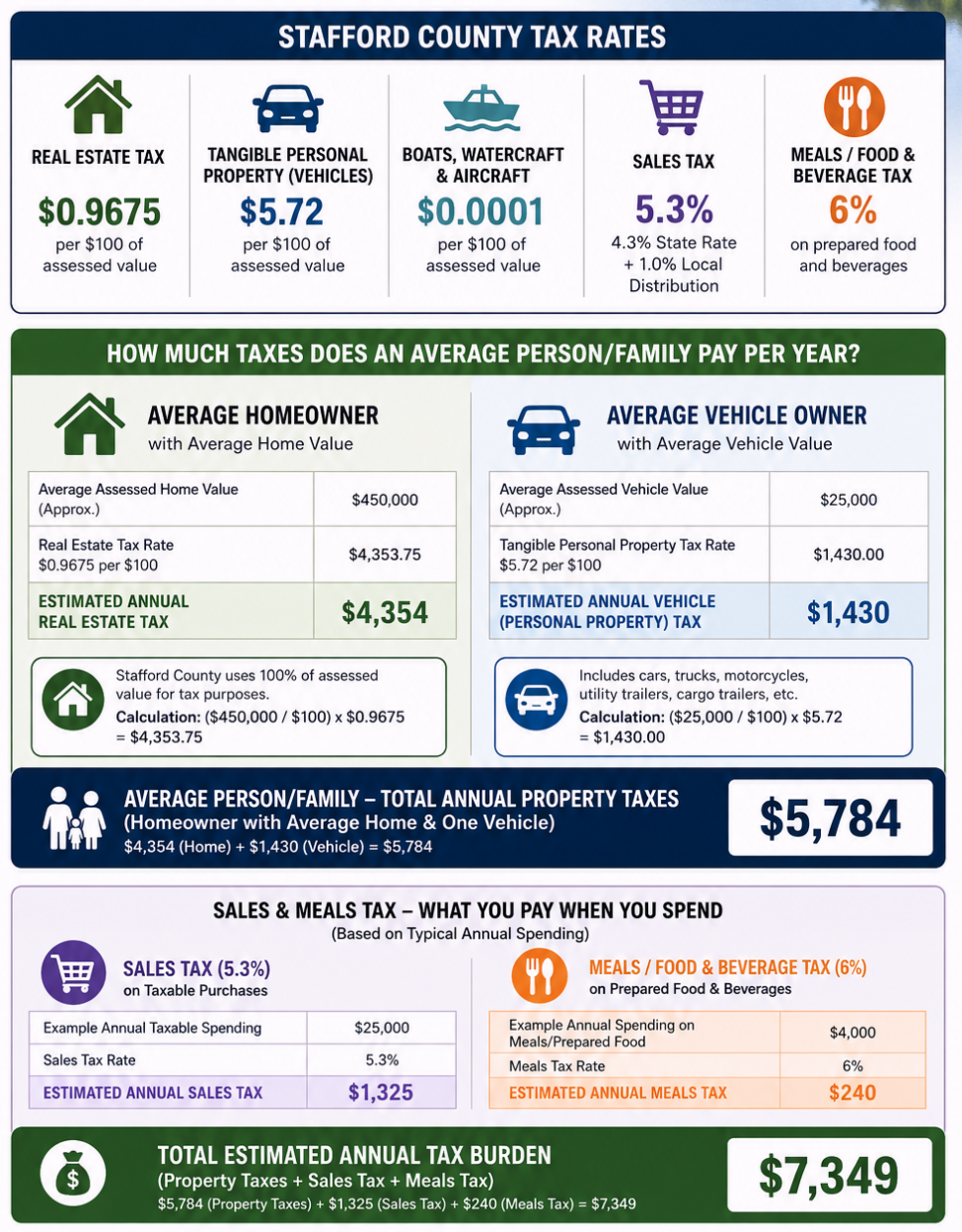
Looking only at Stafford County’s real-estate tax rate produces a surprising result. The 2026 base rate is $0.9675 per $100 of assessed value—almost unchanged from $0.9700 in 2021, 2.27% below the $0.9900 rate in 2016 and 10.42% below the $1.0800 rate in 2011. Compared with 2006, however, the current rate is 53.57% higher than the $0.6300 rate used that year. The county also charges a separate 2026 Fire and Emergency Services levy of $0.014, bringing the combined general real-estate and fire rate to $0.9815 per $100.
Those comparisons do not tell homeowners how much they actually paid. A real-estate bill equals assessed value divided by 100, multiplied by the tax rate. Stafford reassesses real property every two years at 100% of estimated fair-market value. When home prices rise, the county can lower the rate and still collect more money—and an individual homeowner can receive a larger bill even though the published rate is lower.
That is why the 2006 comparison is especially easy to misunderstand. Rapidly rising assessed values allowed the rate to fall sharply from $0.97 to $0.63. After the housing downturn, Stafford reported major declines in assessed values and the rate rose, reaching $1.10 in 2010 and $1.08 in 2011. The rate moved in the opposite direction of property values because the county still needed revenue to operate schools, public safety and other services.
The same mechanism was visible in the 2022 reassessment. County budget records reported an approximately 21% increase in total taxable assessed real property, including about 24% for residential property. The base tax rate fell from $0.97 in 2021 to $0.85 in 2022, but many homeowners still paid more because their taxable values rose substantially. Virginia’s equalized-rate process prevents reassessment alone from automatically increasing the countywide levy by more than 1%; the Board must advertise and hold a public hearing before setting a higher rate. That protection applies to the overall tax base, not a guarantee that every parcel’s bill will stay level.
Recent years show a clearer rate increase: $0.85 in 2022, $0.93 in 2023, $0.8936 in 2024, $0.9236 in 2025 and $0.9675 in 2026. From 2024 to 2026, the base rate rose 8.27%. On a property assessed at a constant $500,000, that change alone raises the base county tax from $4,468 to $4,837.50—a $369.50 annual increase before the fire levy. If the assessment also increased, the bill would rise by more.
The rate increases were adopted to close gaps between available revenue and the cost of Stafford’s spending commitments. For FY2026, the county added $11.8 million for schools, including teacher pay and academic programs; $4.8 million in additional debt service tied to three new schools; and $4.5 million for public safety. The county also funded employee compensation and other operating needs. Even after approving a three-cent increase for 2025, the Board cut another $4.13 million from the proposed plan.
The FY2027 budget brought another increase, from $0.9236 to $0.9675. County documents identify the major drivers as opening and operating three new schools, school and capital-project debt, employee compensation, public-safety staffing, inflation and other rising operating costs. The adopted plan included $15 million in additional school and compensation funding, staffing for a new fire crew, and continued infrastructure investment.
Another major pressure is property-tax relief required by state law for qualifying disabled veterans and supported locally for seniors. Stafford says these obligations were projected to increase by more than $12 million for FY2027 and reduce the taxable base available to support services. The county described the obligation as an unfunded mandate because exempt property generates no corresponding state reimbursement. The policy provides important relief to eligible residents, but its cost is spread across the remaining revenue system.
How has this affected the area? Higher bills increase monthly escrow payments and the carrying cost of owning a home. Landlords may incorporate higher taxes into future rents when market conditions allow, and commercial property taxes can become part of the cost of local goods and services. At the same time, the revenue supports schools, fire and rescue, law enforcement, roads, facilities and employees serving a growing county. These are economic effects and tradeoffs—not evidence that every landlord or business passes through the full increase.
For a $500,000 home at the 2026 combined rate, the general real-estate tax and fire levy total approximately $4,907.50 per year. Special service-district taxes, exemptions, credits and other charges can change an individual bill. The most useful comparison is therefore not the tax rate by itself, but the actual assessment and total tax bill from one reassessment cycle to the next.
The bottom line is that two statements can be true at once: Stafford’s 2026 base rate is lower than it was five, 10 and 15 years ago, yet many homeowners are paying more. Rising market values expanded assessments, while the Board raised the base rate in 2025 and again in 2026 to fund schools, public safety, debt, employee costs, mandated tax relief and other services. Residents evaluating future budgets should watch the equalized rate, the adopted rate, the change in their own assessment, and how each additional penny is allocated.
Sources, documents & image credits
Read the original record
Stafford County Treasurer — current tax ratesUpdated May 4, 2026 · Open original source ↗Stafford County — FY2027 adopted budget summaryApril 2026 · Open original source ↗Stafford County — FY2026 adopted budget and capital programApril 2025 · Open original source ↗Stafford County Commissioner of the Revenue — reassessment FAQReviewed August 29, 2026 · Open original source ↗Stafford County — Budget and CIP archiveHistorical budget records reviewed August 29, 2026 · Open original source ↗Compare the financial stage, linked public documents and outstanding verification gaps.
View financial record →Support Save Stafford
Independent local information. No paywalls. No advertising.Research like this takes time and sometimes requires obtaining public records. Community support helps Save Stafford continue making this information freely available.
No subscription required. Contribute only if you choose. Financial contributions do not purchase editorial influence.